
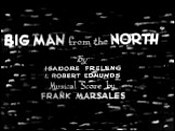
Big Man From The North
Big Man From The North is a 1931 Looney Tunes theatrical cartoon from A Hugh Harman-Rudolf Ising Production, Vitaphone Pictures, directed by Hugh Harman and Rudolf Ising.
- Studio
- A Hugh Harman-Rudolf Ising Production, Vitaphone Pictures
- Distributor
- Warner Bros.
Synopsis
Bosko, an officer of the mounted police, gets assigned the job of bringing in a wanted criminal. He must face the harsh winter weather to bring him in. Traveling to the local saloon in search of the criminal, he starts playing the piano, which ends up seeming like a much better idea to him. However, he soon gets back hot on the trail.
Characters
Bosko, Honey, Criminal
Credits
Directing
- Director
- Hugh Harman, Rudolf Ising
Producing
- Producer
- Hugh Harman, Rudolf Ising
Voices
- Voice
- Carman Maxwell (Bosko), Rochelle Hudson (Honey)
Music
- Music
- Frank Marsales
Animation
- Animator
- Isadore Freleng (as Friz Freleng), Robert Edmunds
Sound
- Sound Recordist
- Bernard B. Brown (uncredited)
Production notes
In this pre-Code cartoon, the criminal gets a sword up his behind (ouch!) and ends up running out of the saloon buck-naked.
Snow is depicted "falling" from the background of the opening titles.
This cartoon is also available as an extra on the DVD of "Smart Money" (1931).
"Chinnin' and Chattin' with May," Music by Seymour Simons, Performed by Bosko and Honey; "Looking for the Lovelight in the Dark," Music by Joseph Burke, Performed by Honey.
Pictures


Reviews
Bosko Stars in More Violent Early Short
In the first of the Looney Tunes offerings for the year 1931, we find our hero Bosko now a part of the great white north mounties. After some amusing Chaplin-esque antics to open the short, Bosko is sent out after a wanted felon. Brandishing a gigantic "pop" gun, he pursues the villainous bandit (very closely related to Mickey Mouse's antagonist) to a saloon where much violence and comedy ensues. All this, of course, to a catchy musical score by Frank Marsales.
Amusing and entertaining, one of the better Bosko shorts of the time.
Elsewhere: Wikipedia