
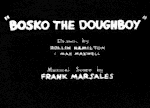
Bosko The Doughboy
Bosko The Doughboy is a 1931 Looney Tunes theatrical cartoon from A Hugh Harman-Rudolf Ising Production, Vitaphone Pictures, directed by Hugh Harman, released on October 17, 1931.
- Studio
- A Hugh Harman-Rudolf Ising Production, Vitaphone Pictures
- Distributor
- Warner Bros.
Synopsis
It is World War I. Rockets, bombs and bullets are everywhere. A bird gets shot, leaving a huge hole- saluting as it falls into a pool of water. An army band is hit, leaving several soldiers in their underwear. Bosko is a toughened soldier in battle who cannot eat beans without being harassed by the enemy's bombs. Bosko is bored with the war until the enemy shoots his photo of Honey- and that is the last straw! Bosko vows to get even- but it is not that easy. He goes into action with violent results. On and on it goes with one comical/horrible scene after another.
Characters
Bosko, Bird, Army Band
Credits
Directing
- Director
- Hugh Harman
Producing
- Producer
- Hugh Harman, Rudolf Ising
Voices
- Voice
- Carman Maxwell (Bosko)
Music
- Music
- Frank Marsales
Animation
- Animator
- Rollin Hamilton, Max Maxwell Carman Maxwell
Sound
- Sound Supervisor
- Bernard B. Brown (uncredited)
Production notes
This graphically animated cartoon has a distinct and sobering anti-war message.
Soundtrack: "Am I Blue?", Music by Harry Akst; "Yankee Doodle," Traditional.
Pictures


Reviews
Looney Tunes No. 09, 1931
This is quite possibly the best of all the Bosko shorts. A departure from the usual "happy dance and fun" style of Bosko's past, this time we see an awful lot of action/shooting for a cartoon, putting our feckless hero through quite a few scary moments. He even has a moment with a photo of lost love Honey. There's quite a lot going on in this short, and while some might see it as making light of war, there's also something essential in the human spirit. "Smile, Darn Ya, Smile!"
Bosko The Doughboy
This is possibly the best Bosko toon ever. War was never so funny.
Elsewhere: Wikipedia