
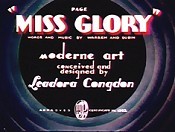
Page Miss Glory
- Studio
- A Vitaphone Production
- Distributor
- Warner Bros.
Synopsis
A pastiche of Busby Berkeley's musical extravaganzas. Hicksville celebrates the arrival of Miss Glory. Abner, the Hicksville hotel bellhop, falls asleep waiting for Miss Glory, a gen-yoo-ine celebrity, to arrive his hotel. He dreams of a New York hotel, all in Art Deco.
Characters
Miss Glory, Abner, Little Girl
Credits
Directing
- Director
- Tex Avery (uncredited)
Producing
- Producer
- Leon Schlesinger
Voices
- Voice
- Bernice Hansen (Little Girl), Tommy Bond (Abner [uncredited]), The Varsity Three
Music
- Music
- Harry Warren, Al Dubin
Crew
Companies and other credits
- Designed By: Leadora Congdon
Production notes
This cartoon (particularly the sequence involving the big-city waiters) is drawn in the style of New Yorker magazine.
Termite Terrace staffers Melvin Millar, Robert Cannon, Bob Clampett, Tex Avery and Chuck Jones are caricatured.
The actual title card reads Page Miss Glory, with "Page" in small letters, as Warner Bros. previously produced a feature titled "Page Miss Glory," and the cartoon had to have a different title.
The full lyrics to the song Page Miss Glory (composed by Al Dubin and Harry Warren), as performed by the Ensemble:
When the moon is new,
I always make a little wish or two,
And when I want someone to tell him to-I do, I do!
I'd Page Miss Glory!
When the stars grow bright
And sprinkle all the shadows with their light
To add a little bit of romance to a lovely night,
I'd Page Miss Glory!
I've never seen a sunset or a rainbow in the sky
That ever could compare with the glory of your eyes!
So when we're apart
And I begin to feel the teardrops start
And when I get that empty feelin' way down in my heart,
I'd Page Miss Glory!
Despite critical praise of this cartoon, director Tex Avery was reportedly dubious about his own work. This was apparently one of the few serious attempts to use a genuine Art Deco look in a cartoon. There are Busby Berkeley-type musical numbers, seen from above, and the New York hotel decor was designed by a real Art Deco expert.
The cartoon ends with caricatures of Tex Avery, Chuck Jones and Bob Clampett waiting outside the hotel.
"Page Miss Glory" and "Nasty Quacks" were the only two Warner Bros. cartoon shorts released without a director credit.
Pictures


Reviews
page Miss Glory
Very nice 1936 Vitaphone Technicolor cartoon; for mature teens/adults. Abner was a lucky kid to dream this! Sorry to say that this 'toon is not yet available in it's full "glory" from WB. (As far as I know) Maybe WB is holding this 'toon back, to add spice to one of their next "releases"?! Very "Art Deco" of the times, & a catchy song that implies a high priced "call girl"....OK, A prostitute these days....??? Worth watching for many reasons. Though no credits are given to the Warner team, it is common knowlege that Fred "Tex" Avery was responsible for the theme/idea..This 'toon wasn't meant for kids; made in a long forgotton time era that some cartoons were made for adults to watch, before the "Feature film" they paid to see.
Page Miss Glory
In the mid 1930's Cosmopolitan Productions, a W. R. Hearst subsidiary for the purpose of producing and promoting Marion Davies, moved from M.G.M. to Warner Brothers. Page Miss Glory was the title of a feature film starring Miss Davies and this cartoon shares not only the song from the feature film, but also its title and a caricature of its star. The action occurs in the "Cosmopolitan" Hotel (get it?). It is all packaged in a dream sequence that goes from a hick town to an art deco metropolis and to say that it is eye candy all the way is to understate. There is a Busby Berkeley style musical number in the middle of the proceedings and of course the Marion Davies character is heavily featured as the mysterious and elusive "Miss Glory." Fun stuff! Don't miss this one.
Page Miss Glory
I think this was the first use of abstract backgrounds in cartoons, something that Chuck Jones and UPA would run with soon afterwards.
Elsewhere: Wikipedia