
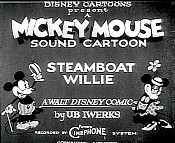
Steamboat Willie
Steamboat Willie is a 1928 Mickey Mouse theatrical cartoon from Walt Disney Studios, directed by Walt Disney and Ub Iwerks, released on July 29, 1928.
- Studio
- Walt Disney Studios
- Distributor
- Celebrity Pictures
Synopsis
A loose parody of Buster Keaton's Steamboat Bill, Mickey is a roustabout on Pegleg Pete's river steamer. After a goat eats the sheet music, Mickey and Minnie use various objects at hand (including a cat on unedited versions!) to create music.
Characters
Mickey Mouse, Minnie Mouse, Pegleg Pete, Cow, Parrot, Cat
Credits
Directing
- Director
- Walt Disney, Ub Iwerks
Producing
- Producer
- Walt Disney, Roy O. Disney
Writing
- Writer
- Walt Disney, Ub Iwerks
Voices
- Voice
- Walt Disney (Mickey Mouse, Minnie Mouse)
Music
- Music
- Wilfred Jackson
Animation
- Animator
- Ub Iwerks, Les Clark, Johnny Cannon, Wilfred Jackson
Music Department
- Conductor
- Carl Edouarde
- Music Performed By
- The Green Brothers
Production notes
The noted release date reflects the initial- albeit limited- release of this short. This cartoon was reworked, sound was added, and the sound version premiered on November 18, 1928 at the Colony Theater in New York.
The first cartoon released with synchronized sound to attract widespread public notice and popularity. (It was not- despite the official Walt Disney Company assertions to the contrary- the first animated cartoon with sound- or even with synchronized sound! (There were quite a number of cartoons with sound that pre-date this film by years.)
This was the third Mickey Mouse cartoon produced, and the second Mickey Mouse cartoon released- Plane Crazy (as a silent cartoon) had a very limited release earlier in the year- and the third Mickey cartoon produced. But when Walt heard Warner Bros. "The Jazz Singer" and its matched, synchronized soundtrack, he decided to rework all three cartoons for sound. Steamboat Willie was the first of the three to which sound was added, though not the first originally produced.
In an infamous test screening, Wilfred Jackson and a few others provided limited music and sound effects to a group watching the screening. As Walt Disney recalled:
The Green Brothers- George Hamilton Green, Joe Green and Lew Green and others in the Green Brothers Novelty Band not only performed the final music for the released version music, but provided Disney with the technical expertise to synchronize the music to the filmed images. The final, sound version premiered on November 18, 1928 at the Colony Theatre in New York City.
Produced on July 29, 1928.
In 1998, Steamboat Willie was one of 25 films added by the Library of Congress' National Film Preservation Board to the National Film Registry.
The first cartoon released with synchronized sound to attract widespread public notice and popularity. (It was not- despite the official Walt Disney Company assertions to the contrary- the first animated cartoon with sound- or even with synchronized sound! (There were quite a number of cartoons with sound that pre-date this film by years.)
This was the third Mickey Mouse cartoon produced, and the second Mickey Mouse cartoon released- Plane Crazy (as a silent cartoon) had a very limited release earlier in the year- and the third Mickey cartoon produced. But when Walt heard Warner Bros. "The Jazz Singer" and its matched, synchronized soundtrack, he decided to rework all three cartoons for sound. Steamboat Willie was the first of the three to which sound was added, though not the first originally produced.
In an infamous test screening, Wilfred Jackson and a few others provided limited music and sound effects to a group watching the screening. As Walt Disney recalled:
When the picture was half finished, we had a showing with sound. A couple of boys could read music and one of them [Wilfred Jackson] could play a mouth organ. We put them in a room where they could not see the screen and arranged to pipe their sound into the room where our wives and friends were going to see the picture. The boys worked from music and sound effects score. After several false starts, sound and action got off with the gun. The mouth organist played the tune, the rest of us in the sound department blamed tin pans and blew slide whistles in the beat. The synchronism was pretty close.
The effect on our little audience was nothing less than electric. They responded almost instinctively to this union of sound and motion. I thought they were kidding me. So they put me in the audience and ran the action again. It was terrible, but it was wonderful! And it was something new!
The Green Brothers- George Hamilton Green, Joe Green and Lew Green and others in the Green Brothers Novelty Band not only performed the final music for the released version music, but provided Disney with the technical expertise to synchronize the music to the filmed images. The final, sound version premiered on November 18, 1928 at the Colony Theatre in New York City.
Produced on July 29, 1928.
In 1998, Steamboat Willie was one of 25 films added by the Library of Congress' National Film Preservation Board to the National Film Registry.
Pictures


Reviews
Walt shows us he knew what he was doing!
Walt took great advantage of the new sound medium with this cartoon. Synchronization of speech still wasn't a sure thing, so he highlights sound effects and music for the gags, all the while showing his confidence in Ub to carry it off. From the opening sequence which must have seemed wonderous to the general audience, he allows the playing of the music to draw them (us) in and the sheer novelty of the stemaboat sounds (complete with anthropomorphic whistles) and just Mickey whistling to catch the eye and ear. He's not content with the novelty of sound to carry the picture though...not enough subastance for Walt...almost right away, he shows there has to be a need for it. Pete's setting off the bell with his tobacco spit shows he knows that the sound and picture weren't the entertaining part, the sounds had to be funny. Then his understanding of emotional flow through music shows through, as the raucous "Turkey in the Straw" begins and the energy builds. Sound gag after sound gag of playing music by using inanimate objects and farm animals (it even sounds funny saying it) propel the rest of the cartoon. Cranking a goat's tail, yankiing a cat's tail, yanking suckling piglets tails, hammering a cows teeth and even using a sows nipples as keys - all the while using sound effects on top of the musical notes instead of just one or the other - show experimentation on what would "read" to the audience, and show his care in making sure that whatever "read" was present so he could refine it later. Any character could have worked in this (Mickey, Oswald, Koko, Felix, etc.) but only Walt could have made it work and use it to see what would work in years to come. A seminal and important film. Highly recommended for both it's entertainment AND it's historical value.
Steamboat Willie
a brilliant start by the disny crew
Steamboat Willie
Mickey should have stayed in this haul-ass persona. I hate the sucky, cloying wuss he became.
Steamboat Willie
I have loved this short, since I saw it on video. Of course, Mickey Mouse wasn't the ONLY one that debuted on this cartoon. It was also his girlfriend, Minnie. Some of you might mistake for Pete's debut. Pete made his first appearance in "Alice Solves the Puzzle" in 1925.
Steamboat Willie
Overall, not a bad cartoon. It's got great synchronization, and the visual aspect is very entertaining. Combined with sound, it's no wonder that it wowed audiences back in the day.
Elsewhere: Wikipedia