
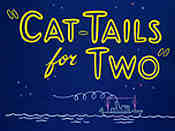
Cat-Tails For Two
Cat-Tails For Two is a 1953 Merrie Melodies theatrical cartoon from Warner Bros. Cartoons, Inc., directed by Robert McKimson, released on August 29, 1953.
- Studio
- Warner Bros. Cartoons, Inc.
- Distributor
- Warner Bros.
Synopsis
Will ya, George, will ya, huh? Will ya let me catch mice with ya, will ya, George? "Awright, but ya gotta promise me not to do stupid things like yer always doin'." Waterfront cats George and Benny go in search of Mexican food (in this case, mice). They board the good ship Pancho Cucaracha, where they meet the fastest mouse in all Mexico. In Laurel and Hardy-like tradition, they sabotage themselves better than Speedy could hope to do!
Characters
George, Benny, Speedy Gonzales
Credits
Directing
- Director
- Robert McKimson
Producing
- Producer
- Edward Selzer
Writing
- Writer
- Tedd Pierce
Voices
- Voice
- Mel Blanc (Speedy Gonzales, George), Stan Freberg (Benny)
Music
- Music
- Carl Stalling
Animation
- Animator
- Rod Scribner, Phil DeLara, Charles McKimson, Herman Cohen
- Layouts
- Robert Givens
Art Department
- Backgrounds
- Richard H. Thomas
Production notes
The first Speedy Gonzales cartoon.
George and Benny are caricatures of George and Lenny, the two main characters in John Steinbeck's novel "Of Mice and Men."
As originally designed, Speedy Gonzales looks very much like a Mexican stereotype here, complete with a shiny gold buck tooth.
George and Benny are caricatures of George and Lenny, the two main characters in John Steinbeck's novel "Of Mice and Men."
As originally designed, Speedy Gonzales looks very much like a Mexican stereotype here, complete with a shiny gold buck tooth.
Pictures


Reviews
Cat-Tails For Two
McKimson did a good job at creating the prototype for Speedy. However, Friz had to finish the job 2 years later. (see Speedy Gonzales - 1955)
Cat-Tails For Two
This cartoon is the first to have Speedy Gonzales. As with other characters like Bugs Bunny, Speedy looks quite different in this early form than in the final form most of us are used to. Speedy's speed and ability to outwit his opponents are constants established in this early cartoon.
Elsewhere: Wikipedia