
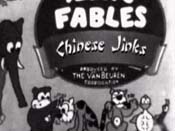
Chinese Jinks
- Studio
- Van Beuren Studios
- Distributor
- RKO Radio Pictures
Synopsis
This is curious but rather charming change of pace for Van Beuren. It opens showing an sailing emperor on his junk attended by several musicians while a coolie propels it. On shore a girl cat walks along singing in what sounds like a Chinese language.
An American sailor boy dog encounters her and is immediately smitten. They head for a nearby bench where he serenades her with the song “Is I In Love – I Is”. She seems interested but plays it coy dropping her handkerchief as she leaves to visit her father in his laundry.
The sailor boy follows her, writes a love note on her handkerchief and tosses it into the shop. When the father sees the message he is upset, drags his daughter outside and confronts the would be boyfriend.
He then takes her to a magician as the sailor tags along. When the sailor realizes what is happening he springs to action and that's where this cartoon adds in a lot of politically incorrect material.
There is, however, a happy ending without any real violence having been necessary.
Characters
Boy, Girl, Villain, Laundrymen
Credits
Directing
- Director
- John Foster, Mannie Davis
Producing
- Producer
- Amadee J. Van Beuren
Sound
- Sound Recording
- RCA Photophone System
Crew
- Synchronization
- Gene Rodemich
Production notes
A series of animated short subjects created by Paul Terry and actor-turned-writer Howard Estabrook. Estabrook suggested making a series of cartoons based on Aesop's Fables. Although Terry claimed he had never heard of Aesop, he felt that Estabrook's idea was something worthwhile. Terry immediately began to set up a new studio called Fables Studios and received backing from the Keith-Albee Theatre circuit.
The earliest films were loose adaptations of the actual fables. Later entries usually revolved around cats, mice, and the disgruntled Farmer Al Falfa. Each short concluded with a "moral" that usually had nothing to do with the actual cartoon itself.
In 1929, Terry quit to start his own TerryToons Studios and John Foster took over the series under Amadee J. Van Beuren's brand new Van Beuren Corporation, a renamed Fable Studios. The series finally came to a close in 1933.
