
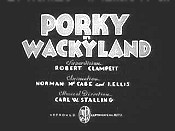
Porky In Wackyland
Porky In Wackyland is a 1938 Looney Tunes theatrical cartoon from A Vitaphone Production, directed by Robert Clampett, released on September 24, 1938.
- Studio
- A Vitaphone Production
- Distributor
- Warner Bros.
Synopsis
Anything can happen in Wackyland- and it does!- as Porky chases the last Do-Do.
Porky ventures into Darkest Africa in search of the last Do-Do bird, and winds up in Wackyland, a surreal place where anything can happen: the sun comes up atop a human pyramid, the Warner Brothers shield comes zooming from the sky, and populated by creatures such as a three-headed "Larry, Curly and Moe" beast.
The Do-Do finally appears, to great fanfare, and eludes Porky by pulling out a pencil and drawing himself a door.
Characters
Porky Pig, The Do-Do, Various Wackyland Citizens
Credits
Directing
- Director
- Robert Clampett
Producing
- Producer
- Leon Schlesinger
Writing
- Writer
- Allen Rose
Voices
- Voice
- Mel Blanc (Porky Pig, The Do-Do, Various Wackyland Citizens), Billy Bletcher (Roaring Goon, [uncredited])
Music
- Music
- Carl W. Stalling
Animation
- Animator
- Norm McCabe (as Norman McCabe), I. (Izzy) Ellis
Production notes
Many of the surreal characters are obviously inspired by the work of Salvador Dali.
The Three Stooges are caricatured. An Al Jolson caricature says, "Mammy, Mammy, my Mammy, no one else's."
This cartoon was remade in 1949 (in color) as "Dough For The Do-Do."
On December 27, 2000, Librarian of Congress James H. Billington announced that "Porky In Wackyland" was one of 25 "culturally, historically or aesthetically" significant motion pictures that he selected to be added to the National Film Registry.
Pictures


Reviews
Porky In Wackyland
Only Bob Clampett could have made this cartoon, for the sheer density of brilliant, corny, and downright bizarre gags. Many of these gags are taking place at the same time, and to list them all would take pages and pages, such was the fevered intensity of Bob Clampett's imagination.
I can watch this cartoon over and over again and discover something new each time. Even more jokes tumble out like a pile of bricks now it's available on DVD (in glorious black and white) and you can slow the speed or freeze frame to catch some of Porky's wild facial expression, or another arcane cultural reference lurking in the corner.
Elsewhere: Wikipedia