
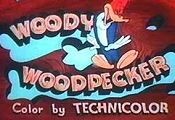
Crowin' Pains
Crowin' Pains is a 1962 Woody Woodpecker theatrical cartoon from Walter Lantz Productions, directed by Paul J. Smith, released on October 16, 1962.
- Studio
- Walter Lantz Productions
- Distributor
- Universal International
Synopsis
Woody awakens from his nap with usual hunger. He spies an old lady on a park bench who's eating hot, buttered, sugar-coated popcorn, but his attempted mooching only gets him a beating with the old lady's umbrella. Woody decides that the city isn't for him, and he flies off to the country. He sees a barn and hears music, so he drops in to see what's happening. A farmer is performing as a one-man band with a dancing crow. Woody hears the farmer tell the crow that he can have lunch after the next chorus, so Woody get an idea. Woody tells the crow about the old lady in the city park with the popcorn. The crow's appetite is whetted, and off he goes. Woody goes to the smokehouse, covers himself with charcoal, and steps in to take the crow's place. Woody then discovers why the crow was so anxious to take off. The lunch turns out to be an ear of corn instead of meat and potatoes. A disgusted Woody goes off to the farmhouse to get some "he-man" food when a misplaced bucket of water ends his disguise. To teach Woody a lesson, the farmer throws a scare into him by threatening to add him to his collection of stuffed birds. Woody agrees not to pull this kind of trick again, so the farmer lets him go. On the way out, Woody meets the crow, in battered condition, who gives Woody a few whacks with an umbrella before Woody departs.
Characters
Woody Woodpecker, Farmer, Crow, Old Lady
Credits
Directing
- Director
- Paul J. Smith
Producing
- Producer
- Walter Lantz
Voices
- Voice
- Grace Stafford (Lantz) (Woody Woodpecker), Dal McKennon (Buzz Buzzard)
Production notes
With arguably the most famous laugh of any cartoon character in history ("ha-ha-ha-HA-ha"), Woody Woodpecker pecked his way into our lives through a 1940 Andy Panda theatrical short entitled Knock Knock. Woody continued to appear in short films throughout the 40's and 50's, and in 1957, the Kellogg's company packaged these theatrical works into the syndicated package The Woody Woodpecker Show.Walter Lantz created the famed bird, and in the show's early days, the animator would host from his office, demonstrating how cartoons were made by showing the viewers at home such essentials as painting cels and drawing storyboards. Woody, an obnoxious mischief-maker, would usually star in the shorts, occasionally taking a backseat to his friends Andy Panda, Wally Walrus, Gabby Gator, Buzz Buzzard, Oswald the Rabbit, and Arctic penguin Chilly Willy.
Woody was by far the most politically incorrect and audacious character of his time. In an era when cartoons were trying to promote a positive message or somehow prove educational, Woody was breaking taboos left and right. The early theatrical shorts were chock full of sexual innuendo, tobacco use, and rampant alcohol consumption. One episode even showed a hotel bill with a charge for "Cocaine" (all of which were later edited out before hitting the airwaves). While other cartoons were trying to do the right thing, Woody was joking, fighting, stealing, and antagonizing.
Another difference between our fine feathered friend and other animated icons is that he didn't always come out on top. Sometimes he'd dig himself too deep into a hole to get out. Perhaps "if Woody had gone to the police, this never would have happened," but then we wouldn't have had so much fun watching him try.
After a three year run from 1957-60, The Woody Woodpecker Show was not seen on network television again until the fall of 1970, when it made its Saturday morning debut. Although his physical appearance was slightly altered and updated, Woody was as big a troublemaker as ever. The immortal show has lived on in syndication ever since leaving network TV in 1977.
In 1999, a brand new Woody Woodpecker Show debuted on the Fox Kids schedule. Woody, Buzz Buzzard, Wally Walrus, Chilly Willy, and Willy's dog pal Smedley were joined by newcomers Winnie Woodpecker, Knothead, Splinter, Dapper Denver Dooley, and Mrs. Meany.


