
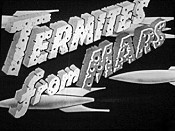
Termites From Mars
- Studio
- Walter Lantz Productions
- Distributor
- Universal International
Synopsis
An astronomer, searching the heavens with his telescope, suddenly sees emerging from the planet Mars a squadron of spaceships that are heading directly toward the Earth. He spreads the news, and in no time, the alarm is being sounded by wireless, telegraph, radio and TV, alerting the whole nation of threatened invasion. Woody's busy cleaning up his apartment in the trunk of a tree while watching his TV set. Suddenly, a Walter Winchell-type announcer interrupts the program to announce to the ships at sea and all people everywhere that termites from Mars have invaded Earth! The TV cameras pick the spaceships up in the sky. The announcer states that the ships are heading for the forests. At the base of the tree in which Woody lives, a ship comes to rest, and out of it comes... not men, but termites. Woody closes all of the doors and windows. When he cautiously opens one window, the termites swam into his apartment and begin their work of destruction. Before you know it, the Martian invaders are eating up everything in sight. Every piece of furniture disappears; only the food remains, which the termites devour. One of the termites goes after Woody with a ray gun. Woody endeavors to fight them with a blowtorch, but the space gun is the superior weapon, and Woody's thwarted in every manner. Finally, in an office, where the termites have destroyed all but the glass top of the desk, Woody discovers a termite chewing on Scotch tape, in which the termite becomes all fouled up. Woody gets a bright idea, grabs the roll of tape and holds it up. In no time, the termites, as well as the spaceships, are stuck to the tape. He spreads the tape throughout the forest, thus turning the tables on the termites, saving the day and winning the battle. At the finish of the picture, Woody opens up his own business: a termite control company. Woody also has the termites doing practical things. He sells the termites as "Little Wonder Termite Tools," to be used as can and bottle openers, pencil sharpeners, record needles, scissors, mousetraps, etc.- while he sits relaxed at a desk directing their endeavors.
Characters
Woody Woodpecker, Termites From Mars, Radio and TV Announcer
Credits
Directing
- Director
- Don Patterson
Producing
- Producer
- Walter Lantz
Voices
- Voice
- Dal McKennon (Radio and TV Announcer [uncredited])
Music
- Music
- Clarence Wheeler
Animation
- Animator
- Ray Abrams, Laverne Harding, Paul J. Smith
Crew
- Sets
- Raymond Jacobs
Production notes
Woody has no dialogue in this cartoon.
In 1953, this cartoon's plot was adapted for a promotional giveaway comic book for Scotch Tape called "Woody Woodpecker Meets Scotty MacTape."
The announcer speaks over radio station WLP (presumably short for Walter Lantz Productions).
With arguably the most famous laugh of any cartoon character in history ("ha-ha-ha-HA-ha?, Woody Woodpecker pecked his way into our lives through a 1940 Andy Panda theatrical short entitled Knock Knock. Woody continued to appear in short films throughout the 40's and 50's, and in 1957, the Kellogg's company packaged these theatrical works into the syndicated package The Woody Woodpecker Show.Walter Lantz created the famed bird, and in the show's early days, the animator would host from his office, demonstrating how cartoons were made by showing the viewers at home such essentials as painting cels and drawing storyboards. Woody, an obnoxious mischief-maker, would usually star in the shorts, occasionally taking a backseat to his friends Andy Panda, Wally Walrus, Gabby Gator, Buzz Buzzard, Oswald the Rabbit, and Arctic penguin Chilly Willy.
Woody was by far the most politically incorrect and audacious character of his time. In an era when cartoons were trying to promote a positive message or somehow prove educational, Woody was breaking taboos left and right. The early theatrical shorts were chock full of sexual innuendo, tobacco use, and rampant alcohol consumption. One episode even showed a hotel bill with a charge for "Cocaine" (all of which were later edited out before hitting the airwaves). While other cartoons were trying to do the right thing, Woody was joking, fighting, stealing, and antagonizing.
Another difference between our fine feathered friend and other animated icons is that he didn't always come out on top. Sometimes he'd dig himself too deep into a hole to get out. Perhaps if Woody had gone to the police, this never would have happened, but then we wouldn't have had so much fun watching him try.
After a three year run from 1957-60, The Woody Woodpecker Show was not seen on network television again until the fall of 1970, when it made its Saturday morning debut. Although his physical appearance was slightly altered and updated, Woody was as big a troublemaker as ever. The immortal show has lived on in syndication ever since leaving network TV in 1977.
In 1999, a brand new Woody Woodpecker Show debuted on the Fox Kids schedule. Woody, Buzz Buzzard, Wally Walrus, Chilly Willy, and Willy's dog pal Smedley were joined by newcomers Winnie Woodpecker, Knothead, Splinter, Dapper Denver Dooley, and Mrs. Meany.
Pictures


Elsewhere: Wikipedia