
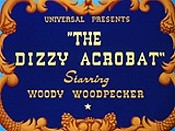
The Dizzy Acrobat
- Studio
- Walter Lantz Productions
- Distributor
- Universal Pictures
Synopsis
Unimpressed by the sideshow barkers' astounding claims, Woody goes to the circus without a ticket, and the circus cop kicks him out. Woody comes back, and the cop tells him that he'll have to work watering an elephant if he stays. A little thing like that doesn't detain Woody for long. Woody connects the elephant's trunk to the fire hydrant and blows up the elephant. The cop isn't pleased with Woody's work and tries to get tough with him, but he doesn't know Woody very well.
The circus performance struggles on while Woody, with the help of a few lions, tigers, elephants and unscheduled acrobatics, that trying to keep him from seeing the circus is unethical, ungentlemanly, and very unlikely to succeed. Woody runs through circus tents, gets the animals in an uproar (making the lion bite off his own tail), and leads cops to the high wire on a bicycle. Chased by the cops, Woody makes the crowd roar as he does wild trapeze stunts.
The circus performance struggles on while Woody, with the help of a few lions, tigers, elephants and unscheduled acrobatics, that trying to keep him from seeing the circus is unethical, ungentlemanly, and very unlikely to succeed. Woody runs through circus tents, gets the animals in an uproar (making the lion bite off his own tail), and leads cops to the high wire on a bicycle. Chased by the cops, Woody makes the crowd roar as he does wild trapeze stunts.
Characters
Woody Woodpecker, Cops, Animals, Professor Bernie Burny
Credits
Directing
- Director
- Alex Lovy
Producing
- Producer
- Walter Lantz
Writing
- Writer
- Ben Hardaway, Milt Schaffer
Voices
- Voice
- Ben Hardaway (Woody Woodpecker), Mel Blanc (Woody's Laugh)
Music
- Music
- Darrell Calker
Animation
- Animator
- Emery Hawkins
Production notes
With arguably the most famous laugh of any cartoon character in history ("ha-ha-ha-HA-ha"), Woody Woodpecker pecked his way into our lives through a 1940 Andy Panda theatrical short entitled Knock Knock. Woody continued to appear in short films throughout the 40's and 50's, and in 1957, the Kellogg's company packaged these theatrical works into the syndicated package The Woody Woodpecker Show.Walter Lantz created the famed bird, and in the show's early days, the animator would host from his office, demonstrating how cartoons were made by showing the viewers at home such essentials as painting cels and drawing storyboards. Woody, an obnoxious mischief-maker, would usually star in the shorts, occasionally taking a backseat to his friends Andy Panda, Wally Walrus, Gabby Gator, Buzz Buzzard, Oswald the Rabbit, and Arctic penguin Chilly Willy.
Woody was by far the most politically incorrect and audacious character of his time. In an era when cartoons were trying to promote a positive message or somehow prove educational, Woody was breaking taboos left and right. The early theatrical shorts were chock full of sexual innuendo, tobacco use, and rampant alcohol consumption. One episode even showed a hotel bill with a charge for "Cocaine" (all of which were later edited out before hitting the airwaves). While other cartoons were trying to do the right thing, Woody was joking, fighting, stealing, and antagonizing.
Another difference between our fine feathered friend and other animated icons is that he didn't always come out on top. Sometimes he'd dig himself too deep into a hole to get out. Perhaps "if Woody had gone to the police, this never would have happened," but then we wouldn't have had so much fun watching him try.
After a three year run from 1957-60, The Woody Woodpecker Show was not seen on network television again until the fall of 1970, when it made its Saturday morning debut. Although his physical appearance was slightly altered and updated, Woody was as big a troublemaker as ever. The immortal show has lived on in syndication ever since leaving network TV in 1977.
In 1999, a brand new Woody Woodpecker Show debuted on the Fox Kids schedule. Woody, Buzz Buzzard, Wally Walrus, Chilly Willy, and Willy's dog pal Smedley were joined by newcomers Winnie Woodpecker, Knothead, Splinter, Dapper Denver Dooley, and Mrs. Meany.
Awards
Academy Award Nominee, Best Short Subject (Cartoon), 1944


