
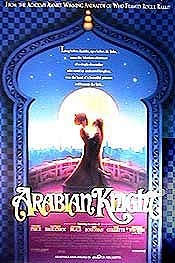
The Thief And The Cobbler
The Thief And The Cobbler is a 1995 Allied Filmmakers animated feature film from Allied Filmmakers, Majestic Film, directed by Richard Williams, released on August 25, 1995.
Also known as: The Princess And The Cobbler, Arabian Knight
- Studio
- Allied Filmmakers, Majestic Film
- Animation studio
- Wang Film Productions Co., Ltd
- Distributor
- Miramax Films
Synopsis
In the ancient Golden City of Baghdad, a shy cobbler struggles to make a living, and to express his love for the princess Yum-Yum. His best friend is a cunning thief who never speaks. The two band together to overcome the evil vizier Zigzag when he tries to seize power. After Zigzag steals the three enchanted golden balls which protect Baghdad, Tack recovers them, saving the beloved city from destruction.
Characters
ZigZag the Grand Vizier, Phido the Vulture, Tack the Cobbler, King Nod, Holy Old Witch, Brigand, Goblet, Tickle, Gopher, Slap, Princess YumYum, Dwarf, Chief Roofless, Hoof, Hook, Maiden from Mombassa, Mighty One Eye
Credits
Directing
- Director
- Richard Williams
Producing
- Producer
- Imogene Sutton, Richard Williams
- Executive Producer
- Jake Eberts
- Associate Producers
- Jacobus Rose, C. Cory M. McCrum-Abdo
Writing
- Writer
- Richard Williams, Margaret French
- Story
- Margaret French
Voices
- Voice
- Vincent Price (ZigZag), Donald Pleasance (Phido), Sean Connery (Tack), Anthony Quayle (King Nod), Joan Sims (Mad, Holy Old Witch), Joss Ackland (Brigand), Kenneth Williams (Goblet, Tickle), Stanley Baxter (Gopher, Slap), Hilary Pritchard (Princess YumYum), George Melly (Dwarf), Windsor Davies (Chief Roofless), Eddie Byrne (Hoof), Thick Wilson (Hook), Miriam Margolyes (Maiden from Mombassa), Chris Greenham (Mighty One Eye), Felix Aylmer (Narrator), Jennifer Beals (Princess Yum Yum), Bobbi Page (Princess Yum Yum- singing), Matthew Broderick (Tack), Eric Bogosian (Phido), Toni Collette (Nurse, Good Witch), Jonathan Winters (The Thief), Clive Revill (King Nod), Kevin Dorsey (One-Eye)
Music
- Music
- Robert Folk (Arabian Knight version)
Production notes
Richard Williams started this ambitious animated film way back in 1968. Working with him were some of the original Disney animators, such as Art Babbit and Grim Natwick, as well as Ken Harris and Emery Hawkins from Warner Brothers. The film was originally self-financed by Williams, with money coming in from his animated commercials. After winning an Academy Award for "Who Framed Roger Rabbit," he got the film financed externally so that it could be completed. This turned out to be a bad decision, because after going over budget, the investors got nervous and pulled the film from him, having it completed by someone else. The film had about 10 to 15 minutes left to complete when it was taken out of Williams' hands. Instead of just completing the film, the person in charge of the completion, Fred Calvert, decided to rework the film to make it more "mainstream." He replaced much of the original scenes with song segments and farmed out the animation. The resulting film was released in a few different edits, including one called "The Princess and the Cobbler" in Australia and one called "Arabian Knight" in the U.S. by Miramax. The Miramax version is much worse because it added constant narration and voices to characters who were intended to be silent. After Disney purchased Miramax, its version ended up on home video under the original title, "The Thief and the Cobbler." Richard Williams' "Work Print" which is the work-in-progress version, is the only way that we can tell what this film could have been. It has not been released, but it can be found as a bootleg.
It is hard, looking at this Miramax video release, to find the spirit of the film as it was originally conceived. The character of the Thief was intended as a mute, a Chaplinesque primitive, subtle and understated. By stealing the three golden balls which protect the Golden City, he unwittingly creates havoc and destruction around him. Superimposed over these scenes is Jonathan Winters' voice, ceaselessly cracking pointless jokes. It is as if those responsible for the completion of the film were terrified of silence, overlaying every quiet moment in the film with endless chatter. Matthew Broderick's narration strives to explain what does not need explaining, robbing the story of subtlety or surprises. I recommend watching with the sound turned off. Save for Vincent Price's brilliant valedictory performance as Zig Zag, the evil Grand Vizier, all but a handful of the carefully selected original voice talents have been replaced with other, less suitable actors.
There remains some beautiful animation in this fractured version of Richard Williams' epic. These include the opening sequence, where the Thief and the Cobbler get tangled up with each other and roll down the steps of the Cobbler's shop, interrupting Zig Zag's march through the city, the chase through the palace through Escher-like optical illusions, and a little of the final war machine sequence.
Richard Williams spent almost 30 years trying to pull off an animation masterpiece, a true work of art, the like of which may never be seen or attempted again. It is sad that so little of his original vision made it into this video release. It is probably little consolation to Williams himself that the Completion Bond Company has since gone out of business, largely as a result of the costs of completing "The Thief and the Cobbler."
This film was supposedly produced by Miramax for an earlier distribution, but was held back because of the Gulf War. The producers believed that America wouldn't be interested in a film set in the Middle East just then.
Reviews
The Thief and the Cobbler
Visually stunning with a good story as well. Too bad it was sabotaged by HACKS.
The Thief and the Cobbler
I got interested in this movie after a seeing a small clip that was shown last year at the Holland Animation Film Festival by Robert Stevenhagen, one of the animators on the opening sequence of "Who Framed Roger Rabbit", who personally knows Richard Williams. That got me interested in the film, I bought the laserdisc, and immediately saw the potential of Williams' intended masterpiece. After a bit of researching, I found a very nice cel from the film for my collection, a wonderful 16 field cel of Princess Yum Yum."
Elsewhere: Wikipedia