
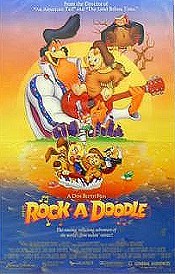
Rock-A-Doodle
Rock-A-Doodle is a 1992 Sullivan Bluth Studios animated feature film from Goldcrest Films, Ltd., Ireland Ltd., Sullivan Bluth Studios, directed by Don Bluth, released on April 3, 1992.
- Studio
- Goldcrest Films, Ltd., Ireland Ltd., Sullivan Bluth Studios
- Distributor
- Samuel Goldwyn Company
Synopsis
Edmond's mother is reading him a bedtime story of a rooster named Chanticleer who sings to make the sun shine while outside, their farm is being flooded by a terrible storm. Hoping to save the family farm from flooding, Edmond calls on Chanticleer to come save them, but evil owl Grand Duke has tricked the rooster- who fancies himself the next Elvis- into leaving the farm for the big city to become a big star. Without the rooster to crow up the sun, the farm becomes a rained-out nightmare, and it is taken over by Grand Duke. To save Chanticleer, Edmond enters the animated storybook world, transformed into a fluffy white kitten. Joining his new farm friends, he sets off toward the big city in search of the rock-and-roll rooster.
Characters
Pinky, Chanticleer, Snipes, Peepers, Edmond, Goldie, Patou, Scott, Mark, Grand Duke, Hunch, Stuey
Credits
Directing
- Director
- Don Bluth
Producing
- Producer
- Don Bluth, Gary Goldman, John Pomeroy
- Executive Producers
- John Quested, Morris F. Sullivan
- Associate Producer
- Thad Weinlein
Writing
- Screenplay
- David N. Weiss
- Writer
- Don Bluth, John Pomeroy, David Steinberg, David N. Weiss, T.J. Kuenster, Gary Goldman
Voices
- Voice
- Glen Campbell (Chanticleer), Eddie Deezen (Snipes), Christopher Plummer (Grand Duke), Sandy Duncan (Peepers), Ellen Greene (Goldie), Phil Harris (Patou (Narrator)), Sorrell Booke (Pinky), Charles Nelson Reilly (Hunch), Will Ryan (Stuey)
- Live-Action Vocal Talent
- Toby Scott Ganger (Edmond), Katheryn Holcomb (Mother), Stan Ivar (Father), Christian Hoff (Scott), Jason Marin (Mark)
Music
- Music
- Robert Folk
- Songs
- T.J. Kuenster
Animation
- Supervising Animator
- Ken Duncan
- Directing Animator
- T. Daniel Hofstedt
- Animator
- Richard Bazley, David Brewster, Jon L. Hooper, Mark Pudleiner
- Computer Animation Director
- Jan Carlee
- Computer Animatior
- Greg Maguire
Art Department
- Production Designer
- Terry Pritchard
Editing
- Editor
- Lisa Dorney, Fiona Trayler
Reviews
Rock-A-Doodle
A DB coffee table book is needed to cover the DB "Eras". He was the one that made Disney wake up and smell the coffee. If not Starbucks, the Java City of independent animation. The Don Bluth production animation assembly line was consistant with the FILMATION approach to tight budget film making. Bluth was able to make his films in the $15M-$20+M range. Don made features not TV stuff. Every film he created would usually start out with allot of ruff animation footage that would be sidelined and not used at all. Really the throw out footage could be up to 1000 to 1500 to 2000 feet on any film he did. But, everyone got more in tune to the characters and the film did get better. ROCK-A-DOODLE is an example of allot of changes and one of the most complicated films he made with a new crew. Ardomore Studio (unionized), Bray, Ireland did allot of live action/roto scenes in that movie therefore they increased the cost of production. Still the budget stayed within latitude. Not to mention DB hiring the live action director from America, Victor French, who almost died of a heart attack on the set at the end of a few weeks. He had to go back. So, DB directed the Ardmore film crew and for the first time he learned about the 180^ degree rule in camera placement. Still within budget. In the beginning soon after Edmond puts his finger on the book picture of the villian owl "DUKE" the film changes into a cartoon. There is this ONE SHOT that cost $60,000 that has a huge mechanical hydraulic tree branch that looked like the Duke's hand. It crashed through the set and almost impailed the second live action Edmond actor (from Woodland Hills, CA) who survived even to the end. Still on budget. There was concern about a cow that was stuck in the mud in the beginning farm sequence. A lasso rope was put around the cow's neck by the father character and then tied to a pick-up truck bumper then he pulled the cow out. It was cut out of the film. About that time a distributor, Gold Crest Entertainment went bankrupt and armored security trucks would come on Fridays to pay the staff in cash. Still the film made it. Just by luck John Pomeroy and Dan Kuenster were at the Dublin studio to orient the animation crew in some really outstanding class/video productions. Dan would rig a fixed video camera over his shoulder and record his lecture/demo for each character and phase the studio covered through several times a week to educate the staff. Video lectures were always saved for reference. At times John Pomeroy would continue the lecture/demos with more character design issues. DB would eventually every month have an animation/layout/back ground painting meeting for his personal stamp of approval. At this point they realized the studio needed a bigger video shooting facility. The rent for big buildings was cheaper 2 miles north of Dublin on Conyingham Road. So, from that point on every shot in the video/stat setup from the creatives in story direction/ storyboard and design were compiled. Either Dan or DB would personally direct the actors who were professional stage actors. The video/film chroma key green sets were designed to the storyboard perspective and allot of "X's" for stat registration were carefully crafted for later production registration. This could also be done in the video camera. The stat unit would tape/paste the registration in place for the animators scene. DB wanted the animators to use the stats for posing and timing for this film and the ones that followed. Don Bluth said, "There is allot of information in those STATS, study them very carefully and by drawing the designed character reference points to each key stat". The timing would be how many stats between poses. Timing could be punched up by throwing out stats, also computer stats could be completely recut/repaste to fit the path of action. Exaggerate the drawings by drawing the blue pencil over the stats as if it were clay on an sculpture wire armature. Studing the stats one by one will allow an animator to notice the arc movements and an important PHRASING of linking groups of dialogue with sets of actions. DB has all along created functional storyboards that when enlarged up to the correct field size would just make it possible for the animator to just ready to go draw/animate. The story character poses/and video stats were OK'ed by Dan or DB or G. Goldman. The layouts were in ruff perspective and were correct with the character in the scene. Collaboration is the key factor going into the final layout/bg painting. The investors in the productions DB created could see the overall vision that the film had a tangible direction and it was gauranteed to be completed. The characters and story reel eventually was all there in the beginning. This would evolve as the tight dead line approached. The script was a collaborative venture. On more of a positive note to mention Dan's brother T.J. Kuenster who is a professional musician/song writer tours in Glen Campbell's main band occasionally. Glen's song writing for Rock-a-Doodle and his Chanticlair voice came together in the end. The film was so complicated nobody would believe it was going to come together at all, just some magic! The Disney studio had plans to produce an animated film called "Chanticlair" but it got shelved in the fifties.
Rock-A-Doodle
rock-a-doodle is one of the best animations i've ever seen! i love the way the lights and water's done on. goldy runs funny though. ^^
Elsewhere: Wikipedia