

Hugó A Víziló
Hugó A Víziló is a 1976 Brut Productions animated feature film from Brut Productions, Hungarofilm Pannaria Filmstudio, directed by William Feigenbaum and József Gémes, released on July 14, 1976.
English title: Hugo The Hippo
- Studio
- Brut Productions, Hungarofilm Pannaria Filmstudio
Synopsis
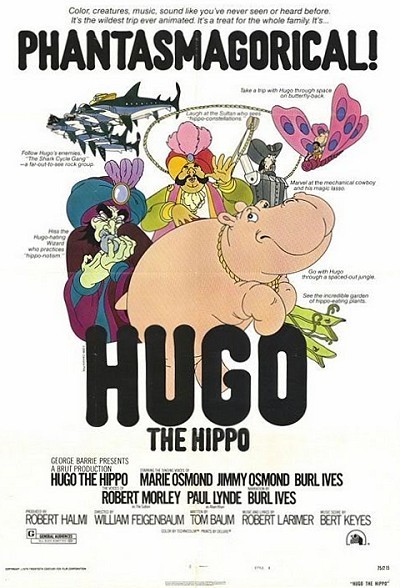
Phantasmagorical! Little-known cult curio Hugo the Hippo is a psychedelic feature in the vein of Yellow Submarine, voiced by such stars as Burl Ives and Paul Lynde, and featuring groovy tunes from Marie and Jimmy Osmond! The wild tale takes place in ancient Zanzibar, where a cigarette-smoking gang of mean sharks inhabits the harbor. Twelve hippos are brought in to defeat the sharks. After a jetty is built, the hippos, also deemed a nuisance, are massacred by Aban Khan, the foremost reprobate in a world populated by hippo-haters. The only survivor is baby Hugo, who suffers persecution. Left to fend for himself, he faces countless (wacky) dangers, including a banana octopus, corncob artilleries, and a wizard who practices hippo-notism. Befriended by Jorma, Hugo perseveres with the little help of some new friends, both animal and human. At Hugo's trial, the Sultan denounces Aban Khan, reminding the court of the hippos' invaluable past service.
Characters
The Sultan, Aban Khan, Jorma, Jorma's Father, Royal Magician, Mr. M'Bow-Wow, Judge, Vocalist, Children, Grownups, Chorus
Credits
Directing
- Director
- William Feigenbaum, József Gémes
Producing
- Producer
- Robert Halmi Jr
- Co-Producers
- George Barrie, Robert Halmi Sr
Writing
- Writer
- Thomas Baum, William Feigenbaum, József Szalóky
Voices
- Voice
- Robert Morley (The Sultan), Paul Lynde (Aban Khan), Ronny Cox (Jorma), Percy Rodriguez (Jorma's Father), Jesse Emmett (Royal Magician), Lance Taylor Sr (Mr. M'Bow-Wow), Len Maxwell (Judge), Burl Ives (Narrator), Marie Osmond (Vocalist), Shawn Campbell (Child), Bobby Eilbacher (Child), Alicia Fleer (Child), Court Benson (Grownup), Pat Bright (Grownup), Al Fann (Grownup), Don Marshall (Grownup), John McCurry (Grownup), Michael Rye (Grownup), Allen Swift (Grownup), Lee Weaver (Grownup), Lewis Morford (Chorus), Jackie Ward (Chorus), Jerry Hausner (Hippo Voice Effects), Frank Welker (Hippo Voice Effects), Nancy Wible (Hippo Voice Effects), Jimmy Osmond
Music
- Music
- Burt Keyes, Robert Larimer
Animation
- Animation Director
- József Gémes
- Animator
- Kati Banki, Zsuzsa Cser, Ferenc Dekany, Edit Hernadi, Ivan Jenkovszky, Miklos Kaim, Szabolcs Szabo, Edit Szalai, Andras Szemenyei, Csaba Szorady, Sarolta Toth
- The Animators
- Kati Banki, Zsuzsa Cser, Ferenc Dekany, Edit Hernadi, Ivan Jenkovszky, Miklos Kaim, Szabolcs Szabo, Edit Szalai, Andras Szemenyei, Csaba Szorady, Sarolta Toth
- Animation and Photography
- HUNGAROFILM PANNONIA FILMSTUDIO, Budapest, Hungary
- Additional Animation Camera
- Frank Buccaria, New York
Art Department
- Production Design
- Graham Percy
- Main Title Design
- Harold Adler
Visual Effects
- Special Voice Effects
- Frank Welker, Nancy Wible, Jerry Hausner
Editing
- Editor
- Sid Cooper, Magda Hap
- Film Editors
- Sid Cooper, Magda Hap
- Assistant Film Editor
- Andrew Mathaias, Andrew Mathaias
- Supervising Film Editor
- Robert Lawrence, Robert Lawrence
- Film Editing
- New York
Sound
- Sound Effects
- Pat Somerset, Bob Biggart
- Recording Studios
- RKO Sound, New York, De Lane Lea, London, England, Burbank, Calif, Channel Sound, New York, New York, United-Western, Hollywood, Calif
- Sound Mixers
- Art Piantadosi, Richard Tyler, Les Fresholtz, Walter Gross
Music Department
- Music Editor
- Eugene Marks
- The Singers
- Laura Hernandez, Paris Gunn, Seth Gunn, Bruce Bynes, Tracy Fries, Aleshia Rynes, Lisa White, Helene Thornton, Erma Thornton, Paulette Steel, Janet Smith, Myna Steele, Rudy Smith, Monica Simmons, Larry Reagans, Lance Redford, Anita Redd, Emma Jones, Linda Hughes, James Haas, Andra Willis, Jackie Ward, Lewis Morford, Ronald Hicklin, Marti McCall
- Electronic Music
- Eric Knight
- Music Coordinator
- Happy Goday
- Music Contractors
- Stanley Krell, Mel Tax
Casting
- Casting
- Mike Fenton, Jane Feinberg
Production Management
- Production Accountant
- Maxwell Meltzer
- Production Secretaries
- Marilyn Anne Tosatti, Barbara Hulac
Crew
- Grownups and Children
- Tom Scott, Don Marshall, H. B. Barnum III, Marc Copage, Charles Walker, Lee Weaver, Richard Williams, Frank Welker, Ron Pinkard, Michael Rye, Marc Wright, Ellsworth Wright, Vincent Esposito, Giamcapeo Esposito, Court Benson, Peter Benson, Mona Tera, Bobby Eilbacher, Len Maxwell, Peter Fernandez, Alan Swift, Derek Power, Frederick O'Neal, Al Fann, Thomas Anderson, Jerome Ward, Shawn Campbell, Lisa Huggins, John McCurry, Alicia Fleer, Lisa Kohane, Bobby Dorn, Pat Bright, Robert Lawrence
- The Songs
- "Wherever You Go, Hugo" sung by Jimmy Osmond, "Harbor Chant" sung by Rudy Clark, Ronald Bright, Ken Williams, J. R. Bailey, "Zing Zong" played
- Whistler
- Gerald Teifer
- Opticals
- Hollywood, Calif, The Optical House, New York
- Narration Written By
- Robert Larimer
- Crew
- Prints by DELUXE
Companies and other credits
- The Voices: The Sultan: Robert Morley
- The Voices: Aban Khan: Paul Lynde
- The Voices: Narrator: Burl Ives
- The Voices: Jorma: Ronny Cox
- The Voices: Jorma's Father: Percy Rodriguez
- The Voices: Royal Magician: Jesse Emmette
- The Voices: Mr. M'Bow-Wow: Lance Taylor, Sr.
- The Voices: Judge: Len Maxwell
- The Songs: "It's Really True"
- The Songs: "I Always Wanted to Have a Garden" and "Somewhere You Call Home" sung by Marie Osmond
- The Songs: "H-I-P-P-O-P-O-T-A-M-U-S"
- The Songs: "Mr. M'Bow-Wow"
- The Songs: "You Said a Mouthful" and "The Best Day Ever Made" sung by Burl Ives
- The Songs: sung by White Water
- Original Soundtrack Available Exclusively on: United Artists Records and Tapes
- Film Editing: Anilive Film Service
- Film Editing: Inc
- Recording Studios: The Burbank Studios
- Recording Studios: A&R Recording
- Opticals: Opticals West/N.S.S
- Opticals: Inc
- Additional Animation Camera: Dasie Animation
- Copyright © MCMLXXV by Brut Productions
- Inc. All Rights Reserved
- A BRUT PRODUCTION
- Distributed by TWENTIETH CENTURY-FOX FILM CORPORATION
Production notes
Animated behind the Iron Curtain in Hungary, financed by the perfume company Fabergé, and directed by New York animation designer Bill Feigenbaum (his only feature film), this unusual production was simply never embraced by the American mainstream and so fell into obscurity.
Only fitfully successful in theaters, "Hugo the Hippo" (its English title) later gained a huge following thanks to its ready availability in the early days of videocassettes. It is still without an official English digital release, leading lovers of "Hugo" to form online communities to share in their search for the lost treasure.
Pictures
Elsewhere: Wikipedia