
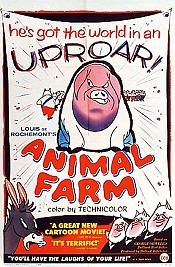
Animal Farm
Animal Farm is a 1954 animated feature film from Louis de Rochemont Film, Halas and Batchelor Production, directed by John Halas and Joy Batchelor, released on December 29, 1954.
- Studio
- Louis de Rochemont Film, Halas and Batchelor Production
- Animation studio
- Halas and Batchelor Cartoon Films
- Distributor
- Distributors Corporation of America (DCA)- US, Associated British Pathe
Synopsis
Manor Farm has fallen on hard times, and Farmer Jones takes it out on his animals. Prize boar-hog Old Major calls a meeting, attended by his fellow pigs, Boxer the horse, Benjamin the donkey and the other animals.
Old Major tells them that while he will die of old age, the others probably won't. The farm is rich enough to support them all if they overthrow Jones and take control- but without adopting his vices, as all animals are equal. The animals sing, cluck, bark, squeak and whinny a song of solidarity, and Old Major dies.
The next morning, the animals break into the grain store after Jones forgets to feed them. Sensing a new determination about them, Jones runs to the pub to get reinforcements. The fighting is fierce, but the humans are forced to flee.
Napoleon leads the animals into Jones's house. They agree that it is no place for them- but Napoleon sneaks back inside afterwards. He adopts a litter of puppies following their mother's death.
The animals draw up a code of conduct: no animal shall sleep in a bed, no animal shall kill another animal, and so on- culminating in the principle that all animals are equal. The farm is renamed Animal Farm, and the animals take over the humans' old jobs. Boxer attracts admiration for his tireless dedication, and the farm becomes far more productive than before.
A meeting is held to discuss the farm's future, the pigs tabling a resolution to spread the revolutionary message to other farms. Napoleon's right-hand pig Snowball analyzes the farm's social and power structure.
Winter comes, along with cold and shortages. Snowball devises a plan involving the animals working more and eating less, but the outcome will be electricity, heat, light and general luxury. Napoleon dismisses this as fantasy, and he sets his dogs (the former puppies) to drive Snowball into exile.
Napoleon adopts the fat pig Squealer as his mouthpiece, and he denounces Snowball as a traitor. Abolishing collective meetings, he says that he'll look after the animals' interests. A windmill is constructed, working the animals to exhaustion. However, they get less food than the pigs, who claim that they need it for their brainpower.
Boxer and Benjamin discover that the pigs have moved into the farmer's old house, and that they are sleeping in his bed. This contradicts one of the farm's edicts, but the animals decide that they've interpreted it wrongly when the words "with sheets" are added.
A trader named Whymper starts doing business with Napoleon. Squealer announces that the chickens will produce eggs for consumption, but they rebel, causing Napoleon to summon his dogs. At a show trial, animals are sent into exile, and the words "without cause" are added to the edict about them not killing each other. Napoleon announces that the revolution is complete, and that the revolutionary song is banned.
Whymper's success is noticed by the jealous farmers, who march on the farm and blow up the windmill. It is painstakingly rebuilt. Years pass, and a new generation of pigs grows up. The windmill has still not been finished, and finally, Boxer collapses in exhaustion.
Napoleon is told that Boxer will never work again. Benjamin predicts a well-earned retirement, but a strange van arrives. Finding Boxer gone, the animals run after the van, but they cannot catch up. They see Boxer whinnying in fear, as the van is going to Whymper's glue factory.
They return to the farm to hear Squealer claiming that Boxer died naturally, and that his last words were in praise of Napoleon. No one believes him. The pigs drink to Boxer's memory with the whisky that they received from Whymper in payment.
More years pass. The revolution is forgotten. The farm prospers, but only the pigs are better off than they were. Pig delegates from far and wide arrive at Animal Farm to celebrate the coming of a new era. The other animals stand outside reading a new sign: "ALL ANIMALS ARE EQUAL BUT SOME ARE MORE EQUAL THAN OTHERS."
The other animals cannot now tell the difference between Napoleon and Farmer Jones. Casting aside their belief in a utopian future to relieve their present suffering, they march on the farmhouse...
Characters
Old Major, Boxer the Cart-Horse, Snowball, Napoleon, Cow, Farmer Jones
Credits
Directing
- Director
- John Halas, Joy Batchelor
Producing
- Producer
- John Halas, Joy Batchelor
- Executive Producer
- Louis de Rochemont
Writing
- Writer
- John Halas, Joy Batchelor, Digby Turpin, Bernard Carey, Borden Mace, Philip Stapp, Lothar Wolff
- Original Novel
- George Orwell
Voices
- Voice
- Maurice Denham (All Animals), Gordon Heath (Narrator)
Music
- Music
- Matyas Seiber
Animation
- Animation Director
- John F. Reed
- Animator
- Arthur Humberstone, Ralph Ayries, Edrick (Eddy) Radage, Harold Whitaker, Frank Moysey
- Layouts
- Geoffrey Martin
Art Department
- Backgrounds
- Digby Turpin, Malvyn Wright, Bernard Carey
- Design
- John Halas, Joy Batchelor, Digby Turpin, Bernard Carey
Camera
- Directors of Photography
- Sidney G. Griffiths, J. Gurr, William Traylor, Roy Turk
Editing
- Editor
- Jack King
Sound
- Sound Recordists
- W. Bland, G. Newberry
- Sound Effects
- Jack King
Crew
- Sponsor
- Louis de Rochemont
Production notes
This was the first feature-length entertainment cartoon made in Great Britain. (According to the studio, this was "Europe's first full-length animated feature." The actual first feature-length cartoon made in Great Britain was "Handling Ships", also produced by Halas and Batchelor Cartoon Films.) The film employed about 80 animators.
It was also the first animated feature produced for an adult audience. Based on George Orwell's political fable which examines allegorically the illusion and disillusion of a Utopian society, it "was the first film to use animation in a less than charming fashion," according to the Educational Media Collection of the University of Washington: "Theatre audiences...could not believe that a cartoon could contain serious messages and painful scenes."
The British release was in 1953; the noted release date reflects the U.S. premiere date. The full U.S. release came on December 29, 1954.
Because of violence content (much is implied, and not shown), as well as the mature theme of the storytelling, it has long been said that this cartoon was given an "X" certificate (no one under 18 admitted) by the British Board of Film Censors when first released in Britain. However, after checking with the BBFC (http://www.bbfc.co.uk/), this is just not the case. The film is, and has always been rated "U" for "Universal" in the United Kingdom, the equivalent of a "G" in the U.S.
Louis de Rochemont Film, the producers of the "March of Time" theatrical documentary series are said to have financed this film, which contains 750 scenes and 300,000 drawings. However, later research suggests that funding was provided directly by the CIA in their ongoing battle against worldwide communism.
Director John Halas said of the film, "This is not communist or anti-communist. It is a fable for all time. It is anti-totalitarian and it has a humanist message."
Awards
Diploma, Berlin Film Festival, 1955.
Critics Choice, Great Britain, 1955.
Diploma of Merit, Durban, 1956
Pictures
Reviews
The Animal Revolution
Though Animal Farm may lack the moralistic, happy-happy approach Snow White may have had, it delivers it's message more vividly and truly makes it an unforgettable classic.
Annoyed with the attitude of Farmer Jones, the pigs lead a revolution and take over the farm for their own. Echoing events in the early USSR or indeed any Communist state, the leaders of the revolution are soon either killed or become more corrupt than the Farmer ever was.
Though some hated it because they were so used to funnies when Animal Farm first came out, it's used worldwide nowadays as a form of anti-Communist propaganda. Even if most toon-addicts are Disneyites or Looney Tunes, I think the British animators deserve a big "well done" for their efforts on this film!
Elsewhere: Wikipedia