
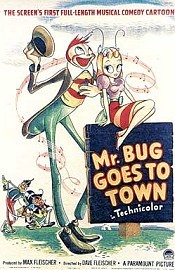
Mr. Bug Goes To Town
Mr. Bug Goes To Town is a 1941 animated feature film from Fleischer Studios, directed by Dave Fleischer, released on December 4, 1941.
Also known as: Hoppity Goes To Town
- Studio
- Fleischer Studios
- Distributor
- Paramount Pictures
Synopsis
Hoppity the grasshopper finds that all is not well when he returns home to Bugville, a vacant lot just 45 inches from Broadway. A skyscraper is scheduled to be built on the site, throwing all his friends and relatives from their homes. Not only that, his girlfriend Honey Bee is being forced to marry the villainous C. Bagley Beetle. All will be saved if only Dick and Mary, the songwriting humans who own the land, can find the money to build the home of their dreams, thereby also providing a new home for the Bugville residents.
Characters
Dick, Mary, Mr. Bumble, Swat the Fly, C. Bagley Beetle, Smack the Mosquito, Hoppity, Honey, Mr. Creeper
Credits
Directing
- Director
- Dave Fleischer
Producing
- Producer
- Max Fleischer
Writing
Voices
- Voice
- Kenny Gardner (Dick), Gwen Williams (Mary), Jack Mercer (Mr. Bumble, Swat), Ted Pierce (C. Bagley Beetle), Carl Meyer (Smack), Stan Freed (Hoppity), Pauline Roth (Honey), Pinto Colvig (Mr. Creeper), Mae Questel (Bee Scout [uncredited]), Guinn "Big Boy" Williams (Narrator), The Four Marshals, The Royal Guards
Music
Animation
- Animation Directors
- Willard Bowsky, Shamus Culhane, H.C. Ellison, Thomas Johnson, Graham Place, Stan Quackenbush, David Tendlar, Myron Waldman
- Animator
- Orestes Calpini, Joseph D'Igalo, James Davis, Nelson Demorest, Anthony Di Paola, Frank Endres, Alfred Eugster, Otto Feuer, George Germanetti, Arnold Gillespie, Thomas Golden, Reuben Grossman, William Henning, Winfield Hoskins, Abner Kneitel, Carl Meyer, Thomas Moore, Joseph Oriolo, Lod Rossner, Hal Seeger, Gordon Sheehan, Irving Spector, Sam Stimson, Nicholas Tafuri, David Tendlar, George Waiss, Harold Walker, John Walworth, Bob Wickersham, Dick Williams, Louis Zukor
Camera
- Photography
- Charles Schettler
Sound
- Sound Effects
- Maurice Manne
Music Department
- Music Director
- Leigh Harline
- Orchestrators (Uncredited)
- Charles Bradshaw, George Parrish, Walter Scharf, Leo Shuken
Crew
Production notes
This film was renamed "Hoppity Goes To Town" after the Fleischer studios closed.
Production lasted from February 5 to mid-November 1941.
The shot of the opening credits, which starts in space and descends to New York City, was produced with a miniature set of the city, consisting of more than 16,000 miniature panes of glass set in wood and plastic models. The set took four months to build.
Songs: "We're the Couple in the Castle," "Katy Did, Katy Didn't" and "I'll Dance at Your Wedding (Honey Dear)," music and lyrics by Hoagy Carmichael and Frank Loesser; "Boy Oh Boy," music and lyrics by Sammy Timberg and Frank Loesser; "Be My Little Baby Bumble Bee," music by Henry I. Marshall, lyrics by Stanley Murphy.
Pictures

Reviews
Mr. Bug Goes to Town
Yeah, sort of a weak story (see first review) but drop-dead gorgeous to look at... gobs of rotoscoping and multiplane camera work, lovely backgrounds - an impossibly sweet big piece of eye candy - WOW!
Mr. Bug Goes to Town
This film, the final feature from the Fleischedr studios, has been sadly neglected over the years. While the story line is not the greatest, it was original (not based on a fairy tale), was based on contemporary images as opposed to a fairyland setting, was "hip" to its time in language and styling, and was brightly colored as opposed to the richer hues of "Gulliver's Travels." Unfortunately, its less than heroic theme, the fact that it did not have truly endearing characters (Swat and Smack try hard, but never quite make it), and that the Fleischers often are drawn into too many "bit of business" rather than dealing with a compelling story, obviously hurt the film at the box-office. Even using top-flight song-writers, the songs in the film are hardly memorable. The fact, too, that it was released just as America entered WWII also affected it success. Still, it is a work worth of note and, while filmed in Florida, still possess the "New York" studio quality that made Popeye and Betty Boop such a hit. Still, it should have its day in the sun. One would hope cable stations dedicated to past films would resurrect this one. After all, the Fleischers did make important contributions to the history of popular film annimations; they should be credited for that!
Elsewhere: Wikipedia