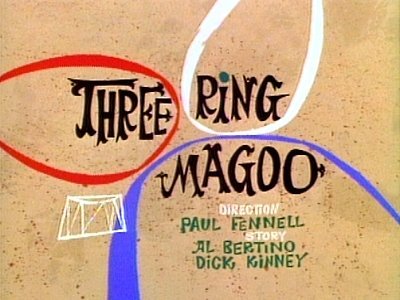
Three Ring Magoo
- Studio
- UPA Productions
- Animation studio
- Jack Kinney Productions, Larry Harmon Studios
- Distributor
- Columbia Pictures Television
Synopsis
Magoo and his Oriental houseboy Charlie burst into another traveling circus thinking that it's a charity ball! Says a politically incorrect Charlie: "Mr. Bloss, Mr. Bloss!"
Characters
Mr. Magoo, Waldo, Prezley, Millie, Mother Magoo, Hamlet the Hamster, Bowser the Cat, Tycoon Magoo, Charlie
Credits
Directing
- Director
- Paul Fennell
Producing
- Producer
- Henry G. Saperstein
Writing
- Writer
- Al Bertino, Dick Kinney
- Script
- Nick George
Voices
- Voice
- Jim Backus (Mr. Magoo, Mother Magoo), Paul Frees (Tycoon Magoo, Prezley), Jerry Hausner (Waldo, Prezley), Daws Butler (Waldo, Prezley), Julie Bennett (Millie)
Music
- Music
- Shorty Rogers, Carl Brandt, George Steiner
Animation
- Animator
- Hank Smith, Bob Maxfield, Frank Braxton, Jerry Hathcock, Ken O'Brien, Chic Otterstrom, Jack Ozark, Irv Spence, Bob Bentley, Ed Solomon
- Layouts
- Don Sheppard, Bob Singer, Dick Ung, Sam Weiss, Gene Hazelton
Art Department
- Production Design
- Lew Keller
- Art Director
- Vic Haboush
- Backgrounds
- Jack Heiter, Bob McIntosh, Bob Abrams, Tony Rizzo
- Color Styling
- Barbara Begg, Thelma Witmer
Editing
- Editor
- Ted Baker
Casting
- Dialogue Director
- Jerry Hausner
Production Management
- Production Manager
- Earl Jonas
Crew
- Production Planning
- Bill Perez, Marty Murphy
Production notes
This series was a low-budget version of the Magoo theatrical cartoons, made specifically for television.
UPA and Kellogg's Cereals had signed a distribution agreement for the televised Mister Magoo series, with Kellogg's thinking it would have the last word on program content. At the last minute, however, UPA decided against any sponsor's veto and backed out of the deal.
UPA managed to sell the series by itself to 150 markets, some of which scheduled episodes in prime time. The popularity of Mister Magoo enabled UPA to sell Dick Tracy, its next series, without making a pilot episode.
UPA ending up setting up a production agreement with Henry Saperstein. Saperstein discarded UPA's reputation for quality and actively entered the made-for-TV cartoon market. Saperstein produced 130 cheaply made Mr. Magoo cartoons which premiered in syndication on November 7, 1960.
From September 18, 1989 to September 16, 1990, episodes from this series and DePatie-Freleng's "What's New, Mr. Magoo?" were rebroadcast (along with UPA cartoons from "The Gerald McBoing Boing Show") on the USA Network under the title of "Mr. Magoo & Friends" as part of "Cartoon Express."