
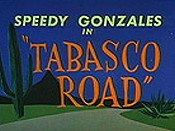
Tabasco Road
- Studio
- Warner Bros. Cartoons, Inc.
- Distributor
- Warner Bros.
Synopsis
After a night of too much tequila, Fernando and Pablo run into problems from el pussy-gatos, and Speedy must save them. The scene is a sleepy Mexican village where the local mice are singing in a miniature cantina within a regular cantina. Speedy is doing the Mexican hat dance, while his buddies are drinking themselves goofy. They leave at closing time, only to be accosted by a big cat hiding in a garbage can. Speedy must act quickly to extract the drunken mice from the cat's mouth, and he quickly plants an exploding firecracker in its place. He tries to get the drunken mice to their homes, but they keep wandering back out onto the street, where Speedy must rescue them again. The cat has finally had enough firecracker down his gullet, and he heads outside the "ceety limits."
Characters
Speedy Gonzales, Pablo, Fernando, Bartender, Mice, Cat
Credits
Directing
- Director
- Robert McKimson
Producing
- Producer
- Edward Selzer
Writing
- Writer
- Tedd Pierce
Voices
- Voice
- Mel Blanc (Speedy Gonzales, Pablo, Cat), Tom Holland
Music
- Music
- Carl Stalling
- Orchestrations
- Milt Franklyn
Animation
- Animator
- Ted Bonnicksen, George Grandpré
Editing
- Editor
- Treg Brown
Crew
- Layouts
- Robert Gribbroek
- Backgrounds
- Bill Butler
Production notes
This Looney Tune short was reissued as a Blue Ribbon Merrie Melodie cartoon.
In September of 1943, beginning with A Feud There Was, Warner Bros. began re-releasing select color cartoons in their "Blue Ribbon" program. Typically the Blue Ribbon reissues received new opening sequences with Blue Ribbon title cards and standardized music. Cartoon production credits were also removed. Between ten and fifteen cartoons were released in any given year, with cartoons coming from as far back as 1935. The reissues continued until the close of the studio in the 1960's.
All Blue Ribbon cartoons were released as "Merrie Melodie" cartoons regardless of the original series. The first "Looney Tunes" short to be included in the Blue Ribbon series was The Hep Cat, which was added in 1949. The only current prints of many of these cartoons are the Blue Ribbon releases, although restoration of these cartoons with original elements and titles is always ongoing.
Awards
Academy Award Nominee, Best Short Subject (Cartoon), 1958
Reviews
Tabasco Road
This is the second and final cartoon of McKimsons to be nominated for an Oscar (alongside "Walky Talky Hawky"), proof that ol' Bob still had the chops at this point to be a decent director.