
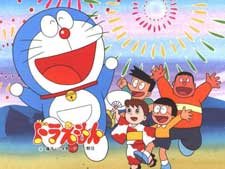
Mirai Kogitte Chou
Mirai Kogitte Chou is an episode of Doraemon (season 2), directed by Nobuo Onuki and Hiroshi Fukutomi, first aired on TV Asahi on June 11, 1980.
English title: Future Checkbook
Series title: ドラえもん
- Studio
- Shin-Ei Animation, Studio Take, Studio Joke, NTV Animation, Shogakukan
- Distributor
- TV Asahi
Synopsis
It starts with Nobita asking his mother for money. She refuses and says to Doraemon that she will give it to him the next day, but he wants it today because of the new comic book series he hasn't bought. And his friends did and will laugh at him if he hasn't bought the comic. Doraemon gives him a checkbook out of his 4D pocket and tells him to write the amount of money on the check and sign it. Nobita writes the amount of money for the comic book, but accidentally writes 1500 yen. Nobita fears that the cashier will not accept, but he successfully buys the book and the cashier gives him 1350 yen. Nobita buys a box of toy airplanes, three cars, a big house and gives Suneo and Gian 1000 yen each with the checkbook. Nobita's mother and uncle give him money but the envelope is empty. He asks Doraemon about this, but he tells him that the checkbook's money is from a future deposit to take out and it was all used up so the envelope is empty. Doraemon takes out a calculator and finds out there will be no more money for Nobita until he is 43 years old and it is summer. Doraemon tells him to ask the cashier for check refunds and he leaves while Doraemon sleeps.
Characters
Nobita Nobi, Doraemon, Shizuka Minamoto, Takeshi "Gian" Goda, Suneo Honekawa, Dorami, Nobisuke Nobi, Tamako Nobi
Credits
Directing
Writing
Voices
- Voice
- Noriko Ohara (Nobita Nobi), Nobuyo Oyama (Doraemon), Michiko Nomura (Shizuka Minamoto), Kazuya Tatekabe (Takeshi "Gian" Goda), Kaneta Kimotsuki (Suneo Honekawa), Keiko Yokozawa (Dorami), Masayuki Kato (Nobisuke Nobi), Sachiko Chijimatsu (Tamako Nobi)
Music
- Music
- Shunsuke Kikuchi
Animation
- Animator
- Fusahito Nagaki, Sadao Tominaga, Hidekazu Nakamura
Art Department
- Storyboards
- Akitaro Daichi, Hideo Nishimaki, Hiroshi Fukutomi, Hiroshi Ishihara, Makoto Moriwaki, Masayuki Oozeki, Mineo Fuji, Minoru Okazaki, Satoshi Anakura, Tomomi Mochizuki, Toshifumi Takizawa, Tsutomu Yabuki
- Character Design
- Eiichi Nakamura
- Design
- Fujiko F. Fujio, Kunio Okawara
Production notes
Originally a 26-episode TV series in 1973, this second series ran over 1000 episodes.
Although this series often has been credited to the Fujiko-Fujio design duo, it actually was created solely by Hiroshi "Fujiko" Fujimoto.
An ongoing series, "Doraemon" is expected to have more than 2,000 episodes by the end of 2004.
Other series included 617 10-minute episodes and more than 900 25-minute episodes.
"Doraemon" movies, lasting about 90 minutes each, have been issued regularly during the Japanese spring break. These started with "Nobita's Dinosaur" (1980) and were followed by "Nobita the Space Colonist," "Nobita's Magic Tower," "Nobita's Undersea Fortress," "Nobita Goes to Hell," "Nobita's Little Star Wars" and "Nobita and the Iron Warrior" (1986).
Later movies included "Nobita's Parrallel Journey to the West" (1988), "Nobita at the Birth of Japan," "Nobita's Animal Planet," "Nobita's Dorabian Nights," "Nobita in Snow Country," "Nobita's Tin-Plate Labyrinth" and "Nobita's Fantastic Three Musketeers."
A 1995 film, "The Birth of Doraemon," traced the series' origins. A new series of films followed: "Nobita's Galctic Express, "Nobita's Clockwork City," "Nobita's South Sea Adventure" (which set a Japanese box-office record for animated films), "Nobita Gets Lost in Space," "Nobita and the Legend of the Sun King" and "Nobita's Winged Heroes."
Dozens of Doraemon TV specials have appeared through the years. Many have been combined with other specials to create additional "movies": "It's New Year!", "It's Summer!", "It's Autumn!", "It's Winter!", "It's Spring!", "Summer Holiday," "Doraemon Meets Hattori the Ninja," "Featherplane," "What Am I for Momotaro?", "Come Back Doraemon," "Doraemon and Itchy the Stray," "Doraemon's Time Capsula for 2001" and "Treasure of Shinugami Mountain."
Doraemon's "little sister" from the future, Dorami-chan, was featured in several short films, starting with "Dorami-chan: Mini-Dora SOS" (1981).