
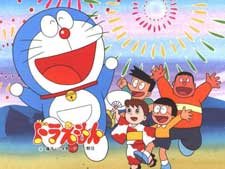
Wrestling Killer
Wrestling Killer is an episode of Doraemon (season 1), directed by Nobuo Onuki and Hiroshi Fukutomi, first aired on TV Asahi on April 6, 1979.
Series title: ドラえもん
- Studio
- Shin-Ei Animation, Studio Take, Studio Joke, NTV Animation, Shogakukan
- Distributor
- TV Asahi
Synopsis
The episode starts with Nobita and Gian being almost late for school and running into each other. An angry Gian then knocks Nobita down, causing him to be late. Doraemon tries to aid Nobita with a Wrestling Killer tool. At first, Nobita mistakes it for a gun, but later understand how it works and uses it to knock Gian down. Later Suneo tricks him and he sets the tool to knock Suneo down, but accidentally caused it to turn against him. He then wastes ¥100 trying to stop the tool. The episode ends with Nobita falling down the stairs.
Characters
Nobita Nobi, Doraemon, Shizuka Minamoto, Takeshi "Gian" Goda, Suneo Honekawa, Dorami, Nobisuke Nobi, Tamako Nobi
Credits
Directing
Writing
Voices
- Voice
- Noriko Ohara (Nobita Nobi), Nobuyo Ôyama (Doraemon), Michiko Nomura (Shizuka Minamoto), Kazuya Tatekabe (Takeshi "Gian" Goda), Kaneta Kimotsuki (Suneo Honekawa), Keiko Yokozawa (Dorami), Masayuki Kato (Nobisuke Nobi), Sachiko Chijimatsu (Tamako Nobi)
Music
- Music
- Shunsuke Kikuchi
Animation
- Animator
- Fusahito Nagaki, Sadao Tominaga, Hidekazu Nakamura
Art Department
- Storyboards
- Akitaro Daichi, Hideo Nishimaki, Hiroshi Fukutomi, Hiroshi Ishihara, Makoto Moriwaki, Masayuki Oozeki, Mineo Fuji, Minoru Okazaki, Satoshi Anakura, Tomomi Mochizuki, Toshifumi Takizawa, Tsutomu Yabuki
- Character Design
- Eiichi Nakamura
- Design
- Fujiko F. Fujio, Kunio Okawara
Production notes
Originally a 26-episode TV series in 1973, this second series ran over 1000 episodes.
Although this series often has been credited to the Fujiko-Fujio design duo, it actually was created solely by Hiroshi "Fujiko" Fujimoto.
An ongoing series, "Doraemon" is expected to have more than 2,000 episodes by the end of 2004.
Other series included 617 10-minute episodes and more than 900 25-minute episodes.
"Doraemon" movies, lasting about 90 minutes each, have been issued regularly during the Japanese spring break. These started with "Nobita's Dinosaur" (1980) and were followed by "Nobita the Space Colonist," "Nobita's Magic Tower," "Nobita's Undersea Fortress," "Nobita Goes to Hell," "Nobita's Little Star Wars" and "Nobita and the Iron Warrior" (1986).
Later movies included "Nobita's Parrallel Journey to the West" (1988), "Nobita at the Birth of Japan," "Nobita's Animal Planet," "Nobita's Anmal Arabian Nights," "Nobita in Snow Country," "Nobita's Tin-Plate Labyrinth" and "Nobita's Fantastic Three Musketeers."
A 1995 film, "The Birth of Doraemon," traced the series' origins. A new series of films followed: "Nobita's Galctic Express, "Nobita's Clockwork City," "Nobita's South Sea Adventure" (which set a Japanese box-office record for animated films), "Nobita Gets Lost in Space," "Nobita and the Legend of the Sun King" and "Nobita's Winged Heroes."
Dozens of Doraemon TV specials have appeared through the years. Many have been combined with other specials to create additional "movies": "It's New Year!", "It's Summer!", "It's Autumn!", "It's Winter!", "It's Spring!", "Summer Holiday," "Doraemon Meets Hattori the Ninja," "Featherplane," "What Am I for Momotaro?", "Come Back Doraemon," "Doraemon and Itchy the Stray," "Doraemon's Time Capsula for 2001" and "Treasure of Shinugami Mountain."
Doraemon's "little sister" from the future, Dorami-chan, was featured in several short films, starting with "Dorami-chan: Mini-Dora SOS" (1981).