
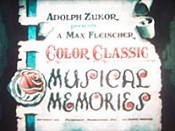
Musical Memories
Musical Memories is a 1935 Color Classics theatrical cartoon from Fleischer Studios, directed by Dave Fleischer, released on November 8, 1935.
- Studio
- Fleischer Studios
- Distributor
- Paramount Studios
Synopsis
An elderly couple reminisce before a fire. The old man gets out their photo album. Through an old stereo viewer, they revisit their shared past, beginning as toddlers in the 1870s and leading up to their wedding and kids. A medley of popular late 19th-century and early 20th-century songs accompanies the couple's memories of their youth and courtship. The couple, in flat painted backgrounds, look through the stereoscope at animation with 3-D backgrounds. In the end, the couple are revealed to be 3-D figures themselves, living in a quaint nostalgia nook in a vast 3-D mansion with beautiful Art Deco styling.
Characters
Old Man, Old Woman
Credits
Directing
- Director
- Dave Fleischer
Producing
- Producer
- Max Fleischer
- Presented By
- Adolph Zukor
Animation
- Animator
- Seymour Kneitel, Roland Crandall, Abner Kneitel, Dave Hoffman, Eli Brucker
Companies and other credits
- Animator: uncredited: William Henning
Production notes
Used the Stere-optical 3-D Process. This short used more 3-D backgrounds than any other Fleischer production.
This short was the last two-strip Technicolor cartoon made at Fleischer Studios.
Jimmy Durante is briefly caricatured.
Pictures


Reviews
Musical Memories
I really like Musical Memories. It's a heart-warming tale of Love through the ages that manages to fit in some Fleischer humour in as well. The 3d effects are overwhelming. I have only seen the redrawn Popeye cartoons so this was my first experience to the wonders of the Stereopticon turntable. I recommend this cartoon, especially for the elderly who can reminisce with the period backdrops and music.
Musical Memories
This short is recalls the lives of an elderly couple as seen through a series of nine set pieces viewed through an old fashion Stereopticon, which was the precursor to today's Viewmaster for seeing three dimensional pictures. It is also significant in that features the greatest use of Fleischer's Stereoptical Process that created all of those wonder three-dimensional background effects. Since each scene is supposed to represent a 3-D slide, each has a 3-D background set up, some having more than one within the set piece. At one time I believe I counted some 30 3-D set ups in this short along. For that reason this short takes the prize for the most use of 3-D effects. It's drawback is the final scene turning from drawn 2-D characters to three dimensional figurines rocking in their chairs. Although many people do not seem to like this short, it deserves better consideration just for the set pieces and the recreation of period atmosphere.