
The Soundmaster
- Studio
- Hanna-Barbera Studios
Synopsis
When it appears that Speedy and the gang steal an advanced battery called the supercell, they must go into hiding. They decide it is the work of imposters, and follow the trail to Dr. Ohm and his assistant Panku, where they find a fake Speed Buggy. They tag along in the Docter's airplane to his secret laboratory at Lost Mountain. He intends to use it in his Soundmaster, a device that uses sound waves to destroy anything. The gang is jailed but escapes and tries to prevent destruction of his first target: Mt. Rushmore. They get the supercell and are pursued by Ohm and Panku.
Characters
Speed Buggy, Debbie, Tinker, Mark
Credits
Directing
- Director
- Charles Nichols (as Charles A. Nichols)
Producing
- Producer
- William Hanna, Joseph Barbera (Executive Producers)
- Associate Producer
- Art Scott
- Creative Producer
- Iwao Takamoto
Writing
- Writer
- Jack Mendelsohn, Len Janson, Jack Kaplan, Norman Maurer, Ray Parker, Larz Bourne, Joel Kane, Woody Kling, Chuck Menville, Larry Rhine
- Story Directors
- John Ahern, Phil Babbitt, Larz Bourne, Steve Clark, Jean Franklin, George Gordon, Jan Green, Clark Haas, Herb Johnson, Dan Mills
Voices
- Voice
- Michael Bell (Mark), Arlene Golonka (Debbie), Phil Luther Jr (Tinker), Mel Blanc (Speed Buggy), Chris Allen, Ron Feinberg, Virginia Gregg, Jim MacGeorge, Sid Miller, Alan Oppenheimer, Mike Road, Charlie Martin Smith, Hal Smith, John Stephenson (Dr. Kluge), Janet Waldo
Music
- Music
- Hoyt Curtin
Animation
- Animator
- Bill Keil, Ed Barge, Oliver Callahan, Lars Calonius, Harry Holt, George Kreisl, Rae McSpadden, Margaret Nichols, Ed Parks, Don Patterson, Dick Thompson, Xenia
- Layout
- John Ahern, Hak Ficq, Moe Gollub, Grank Gonzales, Adam Szwejowski
- Xerography
- Robert "Tiger" West
Art Department
- Production Design
- Bob Singer
- Character Design
- Jerry Eisenberg
- Backgrounds
- Robert Caples, Dennis Durrel, Venita Epler
- Background Styling
- F. Montealegre, Eric Semones
- Ink And Paint Supervision
- Billie Kerns
Camera
- Camera
- Tom Barnes, Ron Jackson, Ralph Migliori, Roy Wade
Editing
- Editor
- Chip Yaras
- Supervising Film Editor
- Larry Cowan
Sound
- Sound Direction
- Richard Olson, Bill Getty
- Effects Editors
- Clifford Kohlweck, Earl Bennett
Music Department
- Music Editor
- Joe Sandusky
- Musical Supervisor
- Paul DeKorte
Production Management
- Production Supervisor
- Victor O. Schipek
- Post-Production Supervision
- Joed Eaton
Crew
- Titles
- Iraj Paran
- Technical Supervision
- Frank Paiker
- Negative Consultant
- William E. DeBoer
Companies and other credits
- A HANNA-BARBERA PRODUCTION
- © 1973 Hanna-Barbera Productions
- Inc
Production notes
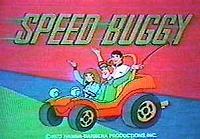
Add Hanna-Barbera's Speed Buggy to the loveable-animated-cars-who-talk list. Employing a Love-Bug-meets-Scooby-Doo concept, Speed Buggy featured three wacky teenagers whose means of transportation was a remote-controlled, rust-colored dune buggy named Speed Buggy. Speed Buggy had two eyes for headlights, a mouth for a grill, and a heart of chrome.
In giving a voice to Speed Buggy, Mel Blanc took the sputterings he provided for Maxwell (the car on Jack Benny's radio show) one step further- Speed Buggy, unlike Maxwell, could actually talk. He also had the very useful ability to fly. Tinker, who looked eerily similar to Scooby Doo's Shaggy, was the mechanic who raced Speed Buggy, while Mark and Debbie were the show's Freddy and Daphne.
Meddling kids in their own right, Tinker, Mark, and Debbie would cruise around in Speed Buggy, looking for adventure and getting themselves into and out of trouble, all the while solving mysteries.
Apparently, the old Scooby-Doo formula still held up. Speed Buggy was another rating winner for Hanna-Barbera, airing on and off for ten years on each of the three major networks. Speed himself also made guest appearances on Scooby's All-Star Laff-a-Lympics.
