
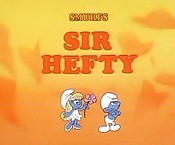
Sir Hefty
- Studio
- Hanna-Barbera Studios, SEPP International
- Animation studio
- Wang Film Productions Co., Ltd
Synopsis
Hefty becomes a knight to slay a dragon that's been setting fire to the village.
Characters
Grouchy, Handy, Lazy, Smurfette, Clumsy, Harmony, Greedy, Jokey, Mother Nature, Azrael, Papa, Sleepy, Vanity, Gargamel
Credits
Directing
- Director
- George Gordon, Bob Hathcock, Carl Urbano, Rudy Zamora
- Supervising Director
- Ray Patterson
- Assistant Directors
- Bob Goe, Terry Harrison
Producing
- Producer
- Gerald Baldwin
- Executive Producers
- William Hanna, Joseph Barbera
- Creative Producer
- Iwao Takamoto
Writing
- Writer
- Creighton Barnes, John Bates, John Bonaccorsi, Doug Booth, Alan Burnett, Patsy Cameron, Claire Geber, William Halsley, Catherine Johnson, Richard Kandrey, Ted Pederson, Michael Reaves (as J. Michael Reaves), Jeff Segal, David Villaire, Marc Scott Zicree
- Story Editors
- Len Janson, Chuck Menville
- Stories Supervised And Based Upon Concepts By
- Peyo, Yvan Delporte
Animation
- Animator
- Bob Hathcock, Bill Hutten, Tony Love, Ron Myrick, Jefferey Hall, James T. Walker, Bob Alvarez, Frank Andrina, Ed Barge, Tom Barnes, Bob Bemiller, Becky Bristow, Kent Butterworth, Lefty Callahan, Joan Case, Rudy Cataldi, John Conning, Jesse Cosio, Doug Crane, Zeon Davush, Ed De Mattia, Joan Drake, Gail Finkeldei, Hugh Fraser, John Freeman, Valerie Gifford, Lenny Graves, Alan Green, Terry Harrison, Fred Hellmich, Aundre Knutson, Walter Kubiak, Rick Leon, Hicks Lokey, Ernesto Lopez, Ed Love, Mircea Manta, Lori McLaughlin, Ken Muse, Costi Mustatea, Fred Myers, Bob Nesler, Margaret Nichols, Eduardo Olivares, Karen Peterson, Spencer Peel, Barney Posner, Bill Pratt, Nelson Rhodes, Joanna Romersa, Don Ruch, Michael Sanger, Lana Sauceda, George Scribner, Kunio Shimamura, Ken Southworth, Richard Trueblood, Bob Tyler, Bonita Versh, John Walker
- Animation Supervisor
- Jay Sarbry
- Assistant Animation Supervisor
- John Boersema
Voices
- Voice
- Michael Bell (Grouchy, Handy, Lazy), Lucille Bliss (Smurfette), William Bill Callaway (Clumsy), Hamilton Camp (Harmony, Greedy), June Foray (Jokey, Mother Nature), Don Messick (Azrael, Papa, Sleepy), Alan Oppenheimer (Vanity), Paul Winchell (Gargamel), Paul Kirby (Narrator), Walker Edmiston, Dick Erdman, Danny Goldman, Ken Mars, John Stephenson, Fred Travalena, Janet Waldo, Lennie Weinrib, Frank Welker
Music
- Music
- Hoyt Curtin
- Musical Supervisor
- Paul DeKorte
Editing
- Editor
- Gil Iverson
- Supervising Film Editor
- Larry C. Cowan
Crew
- Story Editors
- Len Janson, Chuck Menville
- Story Direction
- Ron Campbell, Chris Jenkyns, Larry Latham, George Singer
- Recording Director
- Gordon Hunt
- Animation Casting Director
- Ginny McSwain
- Graphics
- Iraj Paran, Tom Wogatzke
- Title Design
- Bill Perez
- Design Supervisor
- Bob Singer
- Character Design
- Davis Doi, Barbara Dourmashkin, Alice Hamm, Lew Ott
- Layout Supervisor
- Don Morgan
- Key Layout
- Terry Morgan, Floyd Norman
- Layout
- Kurt Anderson, Tom Coppola, Bob Dranko, David Dunnet, Owen Fitzgerald, Jim Franzen, Drew Gentle, Charles Grosvenor, James Hegedus, David Hilberman, Raymond Jacobs, Carol King, Ken Landau, Larry Latham, Jack Manning, Dave O'Day, Michael O'Mara, Phil Ortiz, Scott Shaw
- Background Supervisor
- Al Gmuer
- Background Styling
- Toby
- Backgrounds
- Lorraine Andrina, Fernando Arce, Gil Dicicco, Dennis Durrell, Flamarion Ferreira, Martin Forte, Robert Gentle, Eric Heschong, James Hegedus, Jim Hickey, Paro Hozumi, Michael Humphries, Victoria Jenson, Phil Lewis, Michelle Moen, Andy Phillipson, Phil Phillipson, Jeff Richards, Jeff Riche, Ron Roesch, Bill Proctor, Dennis Venizelos
- Checking and Scene Planning
- Jackie Banks
- Xerography
- Star Wirth
- Ink and Paint Supervisor
- Alison Victory
- Sound Direction
- Dick Olson, Joe Citarella
- Technical Supervisor
- Jerry Mills
- Camera
- Roy Wade, Ray Lee, Steve Altman, Candy Edwards, Chuck Flekal, Curt Hall, Ralph Migliori, Joe Ponticelle, Cliff Shirpser, Paul Wainess, Brandy Whittington, Jerry Whittington
- Dubbing Supervisor
- Pat Foley
- Music Editor
- Daniels McLean
- Effects Editors
- Cecil Broughton, Joe Reitano
- Negative Consultant
- William E. DeBoer
- Post Production Supervisor
- Joed Eaton
- Executives in Charge of Production
- Margaret Loesch, Jayne Barbera
- Crew
- Smurfs (tm)
Companies and other credits
- Story Supervisors: Peyo and Ivan Delporte
- A HANNA-BARBERA PRODUCTION
- In Association With
- Copyright © 1981 Hanna-Barbera Productions
- Inc. And Sepp International
Production notes
Proving that we indeed are a one-world community, NBC president Fred Silverman bought the rights to the Flemish created characters known as the Smurfs and turned them into one of the most successful and smurfiest cartoons ever to hit the air. Created by cartoonist Peyo Culliford in 1957, the Smurfs (called Schtroumpfs in their homeland) had already become popular as American toys when Silverman got the idea of turning the little blue guys into a bunch of big green.
The Smurfs were a group of over 100 dark blue, three-apple tall humanoids who lived in the mushroom homes of Smurf Village. They were led by 543-year-old Papa Smurf (who didn't look a day over 530). Their lives would have been perfect were it not for the villainous Gargamel, a wizard who spent his days trying to capture the wee creatures. Gargamel's cat Azrael added to the menace, always looking for a smurfalicious snack.
The single-emotioned Smurfs-including Brainy, Jokey, Vanity, Grouchy and Clumsy-were later joined by Grandpa Smurf and five Smurflings, who went back in time to become youngsters. Gargamel, too, got a friend in the form of the unscrupulous Scruple.
In 1982 the Culliford characters Johan and his aide Peewit ("Peewee" to U.S. kids) were given their own segments during the expanded, 90-minute Smurfs, but the two humans simply weren't as smurfy as their tiny friends, and thus did not last.
Despite its incredible popularity, The Smurfs actually encountered some controversy. Some adults considered the show quite sexist in its use of the one original female character, Smurfette, who was created by Gargamel as a way to fool the other Smurfs. In reaction to the criticism, the siren was changed into a sweetie via some Papa Smurf magic, and later seasons brought further Smurf femmes like Sassette.
Perhaps the most memorable feature of the show was the use of the word "smurf" in every possible tense and construction. For instance, it wouldn't be unusual to hear a Smurf remark something like, "It's such a smurfy day, I think I'll go smurfing in Lake Smurf."
In any case, the show won two Emmys as Outstanding Children's Entertainment Series and, in 1987, actually did a message episode. In an anti-drug show, Poet Smurf became addicted after rubbing a witch's magic orb, requiring the help of Papa and the gang to overcome his problem.
The Smurfs hit the silver screen in 1984 with La Flûte à Six Schtroumpfs (The Smurfs and the Magic Flute). The film was actually a dubbed version of an older Belgian Schtroumpfs feature, and our teeny weeny heroes didn't even appear until a ways in. The film flopped, but the cartoon continued to rule Saturday morning for the better part of the decade.
In 1989, in an attempt to save the nearly decade-old show, the producers had the Smurfs leaving Smurf Village to visit various times and locations. Fans were smurfed off. The show was cancelled after that season, surviving only in the syndicated package titled The Smurfs' Adventures.
