tom thumb
- Studio
- Galaxy Pictures Limited
- Animation studio
- Project Unlimited
- Distributor
- Metro-Goldwyn-Mayer
Synopsis
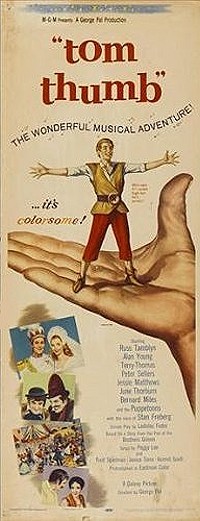
Russ Tamblyn, singing and dancing his heart out, plays the title role in this playful musical adaptation of the Brothers Grimm fairy tale. When a woodcutter spares a special tree, the Forest Queen wants to repay his kindness. She bestows a precious gift upon the man and his wife, who have always longed for a child of their own- a wee boy named "tom thumb." Then a dastardly duo plots to rob the village... and the boy no bigger than the size of your thumb becomes a hero, outwitting the thieves and saving the town's riches. Peter Sellers and Terry-Thomas play a pair of lovable bungling villains.
Characters
Yawning Man, Con-Fu-Shon.
Characters (Live Action): Tom Thumb, Woody, Forest Queen, Ivan, Antony, Jonathan, Anne, The Cobbler, Kapellmeister, Town Crier, Girl, Thumbelina
Characters (Live Action): Tom Thumb, Woody, Forest Queen, Ivan, Antony, Jonathan, Anne, The Cobbler, Kapellmeister, Town Crier, Girl, Thumbelina
Credits
Directing
- Director
- George Pal
- Assistant Director
- David Middlemas
Producing
- Producer
- George Pal (uncredited)
- Associate Producer
- Dora Wright
Writing
- Writer
- Ladislas Fodor
- Story
- Jacob Grimm, Wilhelm Grimm (as The Brothers Grimm)
Voices
- Voice
- Stan Freberg (Yawning Man), Dal McKennon (Con-Fu-Shon)
- Vocal Talent (Live Action)
- Russ Tamblyn (Tom Thumb), Alan Young (Woody), June Thorburn (Forest Queen), Terry-Thomas (Ivan), Peter Sellers (Antony), Bernard Miles (Jonathan), Jessie Matthews (Anne), Ian Wallace (The Cobbler), Peter Butterworth (Kapellmeister), Peter Bull (Town Crier), Ayshea Brough (Girl), Barbara Ferris (Thumbelina), Suzanna Leigh (Extra in "Dancing Shoes" Sequence)
Music
- Music
- Douglas Gamley, Ken Jones
Animation
- Animator
- Wah Chang, Gene Warren, Herb Johnson, Don Sahlin
Crew
- Animators
- Wah Chang, Gene Warren, Herb Johnson, Don Sahlin
- Cinematography
- Georges Perinal
- Assistant Camera, Stop-Motion
- Ralph Rodine
- Camera Operator
- Denys Coop
- Photographic Effects
- Tom Howard
- Grip
- Dennis Fraser
- Art Direction
- Elliot Scott
- Matte Painter
- Judy Jordan
- Costume Design
- Olga Lehmann
- Makeup Artist
- Charles Parker
- Hair Stylist
- Hilda Fox
- Production Manager
- E.J. Holding
- Musical Score
- Douglas Gamley, Ken Jones
- Music Director
- Muir Mathieson
- Songs
- Kermit Goell, Peggy Lee, Fred Spielman, Janice Torre
- Additional Music
- Jeff Alexander, Arthur Morton, Lyn Murray
- Sound
- Peter Davies
- Recording Supervisor
- A.W. Watkins
- Sound Recordist
- John Bramall
- Stunt Double, Peter Sellers
- Bob Simmons
- Continuity
- Angela Martelli
- Choreographer
- Alex Romero
Companies and other credits
- © 1958 Galaxy Pictures Limited
Production notes
Live-action film with puppet-animated toys by Gene Warren and Wah Chang.
For animator-turned-producer George Pal, the road to tom thumb was a long one, but his patience and persistence paid off. Originally a creator of animated films in Paris, Pal eventually carved a niche for himself in Holland with his famed "Puppetoons" - cartoons using molded or carved puppets instead of drawings. After making hundreds of these stop-motion films in Europe, Pal brought his Puppetoons to Paramount, where they remained wildly popular through the 1940s. Though he worked on a few other films, and was even the FX wizard behind The War Of The Worlds, Pal wanted more control over the scope and breadth of his projects, so he eventually gravitated to the MGM studios.
Originally, Pal wanted lead character tom to be a puppetoon among real actors. Donald O'Connor's agent got in touch with Pal and expressed interest in the project. Though Pal considered O'Connor perfect as Woody, O'Connor was interested in portraying tom. Conversations with O'Connor led Pal to decide to use him - instead of a puppetoon character - as tom.
MGM expressed interest in Pal's proposal, but wanted tom to be played by Oscar-nominee Russ Tamblyn. Footage of Tamblyn helped convince Pal that Russ could portray the lead.
Originally, Pal had planned on using Holland's Joop Geesink Studios for the various Puppetoon sequences for the film. Because Geesinks's proposed budget was too high, Pal considered opening his own studio to do the stop-motion animation. However, other responsibilities prevented him to having time for this.
Upon returning to the United States, Pal started looking for stop-motion animators. He remembered that Warren and Chang, who was worked for him making Puppetoon days, had opened Centaur Productions, their own studio. However, Centaur was no longer in business.
Walking down the street one day, Pal ran into Warren, who said that he had joined Chang and Tim Barr in founding effects company Project Unlimited. Then and there, they made an agreement for to have Project Unlimited handle all the stop-motion sequences and effects.
Such sequences as the Yawning Man were done by stop-motion replacement animation, just as the Puppetoons had been made. Chang had to sculpt up to 30 different faces, each with a different expression.
Recalled Chang: "The two main puppet characters where Con-Fu-Shon and the Yawning Man, which I made. Both of those had series faces or heads, and were done in wax. In the Yawning Man's case, a wax face was made and put on the head with registration pins, so that they were always accurately registered. The average number of heads will be from twenty to thirty dialogue heads, and faces that smile or laugh or yawn. First the soundtrack is recorded, and then an exposure sheet is made which shows where every sound and syllable comes. Then the animator will, with this exposure sheet, know where to put each head change and what actions to animate."
Pal was able to deliver tom thumb for around $900,000, which was slightly under budget.
Release date is that of screening in London. American release date was December 22, 1958; general British release date was December 24, 1958.
Soundtrack: "tom thumb's Tune," Music and Lyrics by Peggy Lee; "After All These Years," Music by Fred Spielman, Lyrics by Janice Torre, Sung by Jessie Matthews (Dubbed by Norma Zimmer); "Talented Shoes," Music by Fred Spielman, Lyrics by Janice Torre; "The Yawning Song," Music by Fred Spielman, Lyrics by Kermit Goell, Sung by Stan Freberg; "Are You a Dream," Music and Lyrics by Peggy Lee.
Awards
Academy Award, Best Effects, Special Effects, Tom Howard, 1959.
Nominee, BAFTA Film Award, Best British Actor, Terry-Thomas, 1959.
Nominee, Golden Globe, Best Motion Picture - Musical, 1959.
Nominee, Golden Laurel, Top Male Musical Performance, Russ Tamblyn, Fifth Place, 1959.
Nominee, Golden Laurel, Top Musical, Fourth Place, 1959.
Nominee, WGA Award (Screen), Best Written American Musical, Ladislas Fodor, 1959