

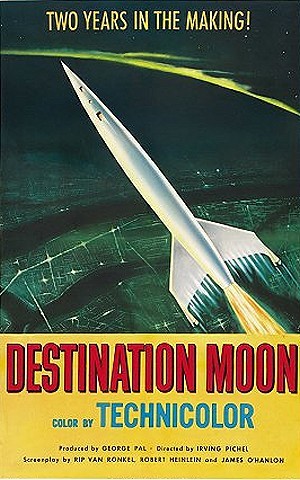
Destination Moon
- Studio
- George Pal Productions
- Distributor
- Eagle Lion Films
Synopsis
A science-based fantasy about the first successful trip to the moon. After years of scientific endeavors, a ship ascends into the heavens. Once free of Earth's atmosphere, the astronauts contend with the dangers of equipment failure and the joys of zero gravity. But tension mounts when the men discover that once on the moon, they may not be able to leave again.
Characters
Woody Woodpecker.
Characters (Live-Action): Jim Barnes, Dr. Charles Cargraves, General Thayer, Joe Sweeney, Emily Cargraves, Factory Worker, Mr. La Porte, Knox Manning, Man, Off-Screen Narrator of Woody Woodpecker Cartoon, Brown, Businessmen at Meeting
Characters (Live-Action): Jim Barnes, Dr. Charles Cargraves, General Thayer, Joe Sweeney, Emily Cargraves, Factory Worker, Mr. La Porte, Knox Manning, Man, Off-Screen Narrator of Woody Woodpecker Cartoon, Brown, Businessmen at Meeting
Credits
Directing
- Director
- Irving Pichel
- Assistant Director
- Harold Godsoe
Producing
- Producer
- George Pal
- Animation Producer
- Walter Lantz
Writing
- Writer
- Rip Van Ronkel (Alford Van Ronkel), Robert A. Heinlein, James O'Hanlon
- Based On The Original Novel By
- Robert A. Heinlein
Voices
- Voice
- Grace Stafford (Woody Woodpecker [uncredited]), Irving Pichel (Narrator)
- Vocal Talent (Live-Action)
- John Archer (Jim Barnes), Warner Anderson (Dr. Charles Cargraves), Tom Powers (General Thayer), Dick Wesson (Joe Sweeney), Erin O'Brien-Moore (Emily Cargraves), Franklyn Farnum (Factory Worker [uncredited]), Everett Glass (Mr. La Porte [uncredited]), Kenner G. Kemp (Businessman at Meeting [uncredited]), Knox Manning (Knox Manning [uncredited]), Mike Miller (Man [uncredited]), Irving Pichel (Off-Screen Narrator of Woody Woodpecker Cartoon [uncredited]), Cosmo Sardo (Businessman at Meeting [uncredited]), Bert Stevens (Businessman at Meeting [uncredited]), Ted Warde (Brown [uncredited])
Music
- Music
- Leith Stevens
Animation
- Animator
- Fred Madison
- Composer, Animation Sequence
- Clarence Wheeler
Art Department
- Production Designer
- Ernst Fegté
Visual Effects
- Special Effects
- Lee Zavitz
Camera
- Camera
- Lionel Lindon
Editing
- Editor
- Duke Goldstone
Sound
- Sound
- William Lynch
Music Department
- Orchestration
- David Torbet
Production Management
- Production Supervisor
- Martin Eisenberg
Crew
- Set Decoration
- George Sawley
- Makeup Artist
- Webster Phillips
- Cartoon Sequences By
- Walter Lantz
- Technical Advisor of Astronomical Art
- Chesley Bonestell
- Technicolor Color Consultant
- Robert Brower
- Technical Supervisor
- John S. Abbott
- Technical Advisor
- Robert A. Heinlein
- Technicians
- Miles E. Pike, Dale Tholen
Companies and other credits
- Cranes: Chapman/Leonard Studio Equipment
- COPYRIGHT MCML GEORGE PAL PRODUCTIONS
- INC
- ALL RIGHTS RESERVED
Production notes
Live action with an animated training film produced by Walter Lantz (guest appearance by Woody Woodpecker). Irving Pichel, the film's director, narrated the animated sequence.
This was the very first time that the voice of Woody was that of Mrs. Walter Lantz (Grace Stafford). After the film's initial theatrical run, Walter Lantz went to work for United Artists. Universal claimed that it owned the rights to the Woody Woodpecker character. Universal informed Eagle-Lion Films (a division of United Artists) that all subsequent non-theatrical releases would have to be without the cartoon. In the years following the release, only a handful of 16mm prints contained the cartoon, which was later reinstated into 16mm prints used for TV broadcasts after an agreement was reached between Universal and United Artists.
Destination Moon was the first major science-fiction film dealing seriously with the prospect, problems and technology of space travel produced in the United States. Eminent science-fiction writer Robert A. Heinlein contributed significantly to the script and served as a technical advisor. Heinlein also published, about the same time as the release of the film, "Destination Moon," a novella of the same name that was based on the screenplay.
The film was promoted through an unprecedented onslaught of publicity in the print media and grossed $5 million. Seven years before Sputnik, the movie clearly spells out a rationale for the space race: unnamed enemies (clearly understood at the time to be the Soviets) are sabotaging the American space program, and unless the West beats them to the moon, they will establish a strategic advantage to conquer the world.
Destination Moon was one of the first science fiction films to attempt a high level of accurate technical detail in telling the story of the first trip to the moon. At the time, nobody had even put a satellite in orbit yet, and everything the filmmakers attempted to show of what space is like was based entirely on what they thought they knew.
Pre-production for the film began in the latter part of 1948. Production lasted from November 14 to December 1949.
Release date is that of New York City premiere; general United States release was August 1950.
Awards
Academy Award, Best Effects, Special Effects, George Pal Productions, 1951.
Academy Award Nominee, Best Art Direction-Set Decoration, Color, Ernst Fegté and George Sawley, 1951.
Nominee, Golden Globes, Best Motion Picture Score, Leith Stevens, 1951.
Hugo Award, Best Dramatic Presentation, 1951.
Bronze Berlin Bear, Best Crime or Adventure, Irving Pichel, Berlin International Film Festival, 1951
Pictures
Elsewhere: Wikipedia