
Coast To Ghost
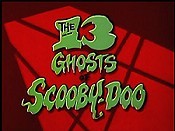
Coast To Ghost is an episode of The 13 Ghosts of Scooby-Doo (season 1), directed by Art Davis and Oscar Dufau, first aired on ABC on November 16, 1985.
- Studio
- Hanna-Barbera Studios
- Animation studio
- Wang Film Productions Co., Ltd
Synopsis
Weerd and Bogel are upset that they did not make it into S.A.P.S. (Spook and Poltergeist Society) so they steal some important magic material which is important to Vincent. Thus the S.A.P.S. and the Scooby-Doo crew are in a race to get this material back.
Characters
Scooby-Doo, Shaggy Rogers, Scrappy-Doo, Flim Flam, Vincent Van Ghoul, Weerd, Bogel
Credits
Directing
- Director
- Art Davis, Oscar Dufau, Tony Love, Don Lusk, Rudy Zamora, Alan Zaslove
- Supervising Director
- Ray Patterson
Producing
- Producer
- Mitch Schauer
- Executive Producers
- William Hanna, Joseph Barbera
- Associate Producer
- Tom Ruegger
Writing
- Story Editor
- Tom Ruegger
Voices
- Voice
- Don Messick (Scooby-Doo, Scrappy-Doo), Casey Kasem (Shaggy), Heather North (Daphne), Susan Blu (Flim Flam), Vincent Price (Vincent Van Ghoul), Artie Johnson (Weerd), Howard Morris (Bogel), Bob Arbogast, Gay Autterson, Hamilton Camp, Vicki Carroll, Peter Cullen, Marshall Efron, Patricia Elliott, Dick Erdman, Bernard Ehrhard, Linda Gary, Joan Gerber, Philip Hartmann, Alice Hirson, Bob Holt, Marilyn Lightstone, Kenneth Mars, Edie McClurg, Sidney Miller, Pat Musick, Alan Oppenheimer, Bob Ridgely, Michael Rye, John Stephenson, Russi Taylor, Les Tremayne, B.J. Ward, Frank Welker
Music
- Music
- Hoyt Curtin
Animation
- Animation Directors
- Robert Goe, Bill Hutten, Rick Leon, Jay Sarbry, Irv Spence, Tim Walker
- Animation Supervisors
- Jay Sarbry, Di Rudder, Mike Longden
- Animator
- Robert Alvarez, Frank Andrina, Miguel Arellano, Brenda Banks, Tom Banks, Tom Barnes, Bob Bemiller, Michael Benet, David Burgess, Oliver Callahan, Rudy Cataldi, Richard Coleman, Jesse Cosio, Daniel De La Vega, Joan Drake, Hugh Fraser, Harry Holt, Bill Hutten, Hicks Lokey, Ernesto Lopez, Ed Love, Tony Love, Ron Myrick, Robert Neslar, Kevin Petrilak, Arnulfo Rivera, Joanna G. Romersa, Virgil Ross, Ken Southworth, Mike Stribling, Bonita Versh, James T. Walker, Allen Wilzbach
- Layout Supervisors
- Charlie Grosvenor, Margaret Parkes, Lew Saw
- Layout Artists
- Teresa Birch, Barrington Bunce, David Dunnet, Drew Gentle, Terry Hudson, Barbara Huggens, Raymond Jacobs, Ray Johnson, Terry Lee Keil, Ken Landau, Greg Martin, Alex McCrae, James Mueller, David O'Day, Linda Rowley, Aaron St. John
- Assistant Animation Supervisors
- Joanna G. Romersa, Mary Guest
- Animation Direction Supervisor
- Chris Cuddington
- Checking and Scene Planning
- Paul G. Strickland, Ellen Bayley
- Xerography
- Star Wirth, Joan Lawson
Art Department
- Character Design
- Sandra Berez, Alice Hamm, Mitch Schauer, Jim Stenstrum, Michael Takamoto
- Background Artists
- Fernando Arce, Martin Forte, Bob Gentle, Jonathan Goley, Bonnie Goodknight, Eric Heschong, Michael Humphries, Phil Lewis, Lorraine Marue, Andy Phillipson, Bill Proctor, Patti Palmer, Jeff Riche, Jeff Richards, Ron Roesch, Marzette Quilty, Gloria Wood
- Background Supervisors
- Al Gmuer, Richard Zaloudek
- Color Key
- Olga Zahorsky
- Ink and Paint Supervisors
- Alison Leopold, Donene Bailey
- Graphics
- Iraj Paran, Tom Wogatzke
Camera
- Camera
- Steve Altman, Daniel Bunn, Curtis Hall, Glen Higa, Raymond Lee, Ralph Migliori, Dave Valentine, Brandy Whittington
- Camera Supervisor
- Fernando Letteri
Editing
- Editor
- Robert Ciaglia, Robert Ciaglia
- Supervising Film Editor
- Larry C. Cowan, Larry C. Cowan
- Show Editor
- Gil Iverson
Sound
- Sound Direction
- Alvy Dorman, Phil Flad
- Effects Editors
- David Cowan, Michele Iverson, Tim Iverson, Carol Lewis, Catherine MacKenzie, Jerry Winicki
Music Department
- Music Editors
- Cecil Broughton, Daniels McLean, Terry Moore, Joe Sandusky
- Music Supervision
- Paul DeKorte
Casting
- Recording Director
- Gordon Hunt
- Animation Casting Director
- Andrea Romano
Production Management
- Production Managers
- David Salter, Larry Smith, Gary Smith
- Production Coordinator
- Jack Pietruska
- Post Production Supervisor
- Joed Eaton
Crew
- Story Direction
- Cullen Blaine, Scott Jeralds, Bob Nesler, Mitch Schauer, Bob Taylor, Roy Wilson
- Special Material
- Chuck Couch
- Design Supervisors
- Jim Stenstrum, Mitch Schauer
- Titles
- Mitch Schauer
- Technical Supervisor
- Jerry Mills
- Dubbing Supervisor
- Pat Foley
- Negative Consultant
- William E. DeBoer
- Crew
- Jean MacCurdy
Companies and other credits
- Executives in Charge of Production: Jayne Barbera
- A
- HANNA-BARBERA
- PRODUCTION
- Copyright © 1985 Hanna-Barbera Productions
- Inc
- All Rights Reserved
Production notes
When Frank Sinatra sang "Strangers in the Night," did he know he would inspire the name for the longest-running cartoon on network TV? Probably not. Nonetheless, that Great Dane named Scooby-Doo (as in "dooby dooby doo") has appeared on television under no less than twelve titles.
It all began in 1969 as Scooby-Doo, Where Are You? The travelling companion of four hep-cat teenagers, Scooby-Doo helped solved mysteries while simultaneously murdering the English language (though the fact that he could even speak should count for something). Scooby's best friend was the skinny, goofy Shaggy, with whom he shared a love for Scooby snacks, among other delicacies. Also along for the ride was the much hunkier Freddy, the babeslicios Daphne, and Velma, the brainy girl who did most of the mystery cracking.
The inexplicable fivesome tooled around in the Mystery Machine (a groovy painted van), ending up in some pretty creepy towns menaced by ghosts, ghouls or mummies. Freddy would "take the girls," leaving Scooby and Shaggy to fend for themselves, usually ending up in each other's arms out of fear. After an extensive chase scene/musical sequence, the villain would be caught, reveal his true identity and curse those meddling kids for foiling his plans.
This incarnation lasted for two seasons before reruns took over. From 1972 to 1974, the show became The New Scooby-Doo Movies. This format had the kids meeting up with such guest stars as Mamma Cass, the Globetrotters, Sonny and Cher, and Don Knotts (all playing themselves) to solve more mysteries.
For one season in 1976, the gang became half of The Scooby-Doo/Dynomutt Show, sharing the bill with the "robonic" Dynomutt and his human superhero partner, The Blue Falcon. Scooby's gang was joined by Scooby's cousin Scooby-Dum, who (you guessed it) was dumb.
From '76 to '80, Scooby was granted ninety minutes under the title Scooby's All-Star Laff-A-Lympics (later renamed Scooby's All-Stars). This show featured a plethora of Hanna-Barbera characters—dating as far back as the 50's—engaged in a variety of competitions.
In addition to rerunning Scooby-Doo, Where Are You? in 1978, ABC paired Laff-A-Lympics with a new show, Scooby and Scrappy-Doo. This show introduced Scoob's short and confident nephew, who, though younger than Scooby, had much clearer speech. In 1980 the cowardly elder Doo was paired with a famous mini-millionaire in The Richie Rich/Scooby-Doo Show.
Scooby and Scrappy were still together in 1982, but now they split their time with another canine in The Scooby and Scrappy-Doo/Puppy's New Adventures Hour. Joining these new shows were airings of reruns now called The Best of Scooby-Doo. In 1984 The New Scooby-Doo Mysteries (which brought back the teens as well as holding on to Scrappy) were aired, as were a bunch of reruns, this time called Scary Scooby Funnies.
In The 13 Ghosts of Scooby-Doo (1985-86), Scooby, Scrappy, Shaggy and Daphne were joined by 9-year-old Flim Flam. The group, helped by warlock Vincent Van Ghoul (Vincent Price), fought off wicked sorcery. That season the Great Dane could also be seen in another rerun collection, Scooby's Mystery FunHouse. In 1986 Scooby could only be seen in reruns of Laff-a-Lympics.
The airwaves were deprived of Scooby for two years. Then, in 1988, a new show called A Pup Named Scooby-Doo was produced. Like many cartoons of the time, this show took familiar characters back to their early years. Thus, Shaggy, Freddy, Velma and Daphne were now preteens. Scooby, of course, was but a pup. This version had the kids constantly running into the character Red Herring (wink, wink), whom the gang always suspected of committing crimes. This show ran in reruns until 1993, when it finally left network television.
And then, the Scooby dry spell. Ten years of now new Scoobs. OK, sure, we had the occasional direct-to-video releaese with the Mystery Crew, but no more reegular television. Ninally, in 2002, we got What's New, Scooby-Doo?. This is also the first show since Scooby-Doo and Scrappy-Doo to contain the gang in it's original format: Fred, Daphne, Velma, Shaggy and Scooby-Doo.
Shaggy & Scooby-Doo Get a Clue! saw the first real redesign the crew has ever seen. The best way to describe the new look is to just avoid it altogether.
Scooby-Doo! Mystery Incorporated is the most recent version of the show. Back to the original models (thanks GOD!). Fred, Daphne, Velma, Shaggy and their talking dog Scooby-Doo are back, solving mysteries in the spooky town of Crystal Cove, a sleepy coastal village that boasts a long history of ghostly sightings, werewolves and glowing deep sea divers.
It's interesting to note that while the show itself underwent many changes, the characters did not. Aside from a modified Daphne appearing in The 13 Ghosts of Scooby-Doo, the gang retained their late-sixties garb well into the eighties and nineties. This included knee-highs, a mini-skirt and lumpy turtleneck sweater for Velma, a rockin' minidress and head scarf for Daphne, and groovy bell-bottoms for the guys. Scooby remained in his natural canine glory.
Scooby-Doo may have left Saturday morning, but his work is far from over. Scooby continues to answer the call, appearing semi-regularly in direct-to-video cartoon features. As long as mysteries need solving, Scooby-Doo will come through (and then he'll have himself a Scooby Snack... that's a fact).