
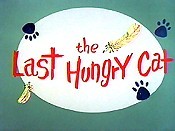
The Last Hungry Cat
- Studio
- Warner Bros. Pictures, Inc., Vitaphone Releases
- Distributor
- Warner Bros.
Synopsis
What would happen if Alfred Hitchcock directed a Sylvester and Tweety cartoon? As this spoof of "Alfred Hitchcock Presents" begins, a Hitchcock-type voiceover (who is never seen, apart from a silhouette of a bear) informs us that we are about to witness a murder. Sylvester slips when making a grab for Tweety in Granny's flat, and falls dazed to the floor as one of Tweety's feathers lands in his mouth. Tweety runs off. Sylvester comes to and finds the feather lodged between his lips. Thinking that he has swallowed and killed Tweety, he suffers terrible remorse as the Hitchcock-like character chides him for his "crime": "Sardines and milk weren't enough. You had to commit murder!" Sylvester sees a newspaper headline ("Police hunt 'The Cat'") and cracks, running into the streets confessing, all the while heckled by the Hitchcock narrator, who accuses him of murdering Tweety. Sylvester returns to Granny's place, where he finds that he didn't eat Tweety after all.
Characters
Sylvester, Tweety, Granny Sweet, Alfred Hitchcock-Like Bear
Credits
Directing
- Director
- Isadore Freleng (as Friz Freleng)
- Co-directed By
- Hawley Pratt
Producing
- Producer
- David H. DePatie
Writing
- Writer
- John Dunn, David Detiege (as Dave Detiege)
Voices
- Voice
- Mel Blanc (Sylvester, Tweety), June Foray, Ben Frommer
Music
- Music
- Milt Franklyn
Animation
- Animator
- Gerry Chiniquy, Virgil Ross, Bob Matz, Art Leonardi, Lee Halpern
Art Department
- Backgrounds
- Tom O'Loughlin
Editing
- Editor
- Treg Brown
Production notes
The scenes in which Sylvester chain-smokes, drinks coffee and takes sleeping pills are cut from T.V. prints.
The first Tweety and Sylvester cartoon animated by Lee Halpern, the first animated by Art Leonardi, and the first animated by Bob Matz.
Tweety does not say "I taw a puddy tat" in this cartoon.
The first Tweety and Sylvester cartoon animated by Lee Halpern, the first animated by Art Leonardi, and the first animated by Bob Matz.
Tweety does not say "I taw a puddy tat" in this cartoon.
Pictures


Reviews
The Last Hungry Cat
This one COULD'VE been a classic, but.....
Art Davis had left Freleng's unit, & he wasn't easily replaced. Leonardi & Matz (Gerry Chiniquy's assistant, whom Virgil Ross described as "a slow, methodical worker") and Art Leonardi show their lack of experience in this & succeeding Freleng films. Leonardi, though, would go on to do good work as storyboard man & director at DePatie-Freleng Enterprises, particularly in the "Inspector" series.
Also, Freleng & music man Milt Franklyn didn't need to worry about STEALING the Hitchcock theme (a "sound-alike" tune is used)........the Hitchcock melody is really a public-domain piece, Charles Gounod's "Funeral March Of A Marionette." Hanna-Barbera felt free to use it in "The Flintstones," for instance.
The Last Hungry Cat
Hitchcock was THEE best director in Hollywood. The fact that Friz studied him shows that he knew what good directing was and it showed in his cartoons.
The Last Hungry Cat
This one could've been an all-time classic, if Freleng had done it just a couple months earlier........
The core problem is, the pedestrian animation. Long-timers Chiniquy & Ross do their usual professional job, but Freleng's unit had lost Art Davis (who'd joined Jones' unit for UPA's "Gay Purr-ee"--Davis animated nearly all of the scenes with Meow-rice).
In Davis' place were Chiniquy's assistant, Bob Matz (whom Ross described as "a slow, methodical worker"), Art Leonardi (who'd find his true metier at DePatie-Freleng, storyboarding & directing "The Inspector") and Lee Halpern. Their amateurishness is painfully evident here.
Another thing that kinda bugged me--Freleng & musical director Milt Franklyn didn't need to worry about ripping off the Hitchcock theme--it's really a public-domain piece, Gounod's "Funeral March of a Marionette."