
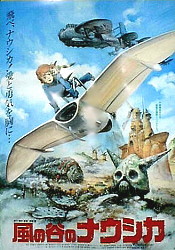
Kaze No Tani No Naushika
Kaze No Tani No Naushika is a 1984 Studio Ghibli animated feature film from Hakuhodo, Tokuma Shoten, Nibariki, Tôei, directed by Kazuo Komatsubara and Hayao Miyazaki, released on March 6, 1984.
Also known as: 風の谷のナウシカ, Kaze No Tani No Nausicaä
English titles: Nausicaä of the Valley of Wind, Nausicaä, Nausicaa, Warriors of the Wind
- Studio
- Hakuhodo, Tokuma Shoten, Nibariki, Tôei
- Animation studio
- Topcraft
- Distributor
- Toei Kabushiki Kaisha
Synopsis
In the far future, man has destroyed the Earth in the "Seven Days of Fire". Now, there are small pockets of humanity that survive. One pocket is the Valley of Wind where a princess named Nausicaä tries to understand, rather than destroy, the Toxic Jungle which surrounds her valley, expelling deadly poisonous gas, and which is guarded by giant mutated insects. Although ocean breezes protect the valley from these poisons, a battle for earthly domination threatens this stability.
Characters
Nausicaä, Jihl, Oh-Baba, Yupa, Mito, Goru, Gikkuri, Niga, Teto, Asbel, Rastel, Mayor of Pejite, Rastel's Mother, Kushana, Kurotowa, Commando, Pejite Citizens, Pejite Girl, Torumekia Soldiers
Credits
Directing
- Director
- Kazuo Komatsubara, Hayao Miyazaki, Mitsuyoshi Nakamura
- Assistant Director
- Kazuyoshi Katayama, Takashi Tanazawa, Takashi Watabe, Tomihiko Ohkubo
Producing
- Producer
- Isao Takahata
- Executive Producers
- Tohru Hara, Michio Kondô, Yasuyoshi Tokuma
Writing
- Writer
- Hayao Miyazaki
Voices
- Voice
- Sumi Shimamoto (Nausicaä), Mahito Tsujimura (Jihl), Hisako Kyôda (Oh-Baba), Gorô Naya (Yupa), Ichirô Nagai (Mito), Kôhei Miyauchi (Goru), Jôji Yanami (Gikkuri), Minoru Yada (Niga), Rihoko Yoshida (Teto, Girl C), Masako Sugaya (Girl A), Takako Sasuga (Girl B), Chika Sakamoto (Boy A), Tarako (Boy B), Yôji Matsuda (Asbel), Mîna Tominaga (Rastel), Makoto Terada (Mayor of Pejite), Akiko Tsuboi (Rastel's Mother), Yoshiko Sakakibara (Kushana), Iemasa Kayumi (Kurotowa), Tetsuo Mizutori (Commando), Takeki Nakamura (Pejite Citizen), Takako Ôta (Pejite Girl), Bin Shimada (Pejite Citizen), Shinji Nomura (Torumekia Soldier), Hisako Ayuhara (Boy), Yoshitada Ôtsuka (Torumekia Soldier)
- English Version
- Alison Lohman (Nausicaä), Cam Clarke (Prince Milo), Edward James Olmos (Mito), Patrick Stewart (Lord Yupa), Shia LaBeouf (Asbel), Uma Thurman (Kushana), Ashley Rose Orr (Peasant Girl), Chris Sarandon (Kurotowa), Emily Bauer (Princess Lastelle), Frank Welker (Gol), James Taylor (Muzu), James Arnold Taylor (Muzu), Jeff Glen Bennett (Gikkuri), Jodi Benson (Lastelle's Mother), Mark Hamill (Mayor of Pejite), Mark Silverman (King Jihl, Niga), Tress MacNeille (Obaba), Tony Jay (Narrator), Aimee Roldan, Ashley Edner, Bridget Hoffman, David Cowgill, Edie Mirman, Grace Rolek, Ike Eisenmann, Jean Gilpin, Bridget Hoffman, Jordan Orr, Lynnanne Zager, Mitch Carter, Molly Keck, Newell Alexander, Nicholas Guest, Paul Butcher, Peter Renaday, Richard Miro, Riff Hutton, Robert Clotworthy, Rosemary Alexander, Ross Simanteris, Sherry Hursey, Stephen Apostolina, Tom Amundsen, Wendy Cutler
Music
- Music
- Jô (Joe) Hisaishi
Animation
- Animation Director
- Kazuo Komatsubara
- Animator
- Kazuo Komatsubara, Takashi Nakamura, Kazuyoshi Katayama, Hideaki Anna, Takashi Watanabe
- Key Animation
- Ai Kagawa, Akinobu Hane, Hideaki Anno, Junko Ikeda, Kazuyuki Kobayashi, Kitaro Kousaka, Makiko Futaki, Noboru Takano, Osamu Nabejima, Osamu Tabeshima, Shouji Tomiyama, Shuichi Ohara, Shunji Saida, Shuuichi Kohara, Tadakatsu Yoshida, Tadashi Fukuda, Takanori Hayashi, Takashi Nakamura, Takashi Watabe, Tsukasa Tannai, Yôichi Kotabe, Yoshinori Kanada
- Assistant Key Animator
- Junko Ikeda, Masahiro Yoshida
- Finish Animation
- Chiharu Mizuma, Emiko Ishii, Hiromi Nagamine, Makiko Yamauchi, Masayo Yoshida, Richiko Shimizu, Taeko Oumi, Tomohiro Komuro, Wakako Kanno, Yumi Furuya
- Animation Check
- Hideo Hiratsuka, Tadashi Ozawa
- In-Between Animation
- Daijirou Sakamoto, Hiroshi Kouji Iwai, Junko Yano, Kazuhiro Ikeda, Kazuhisa Nagai, Kiyo Mizutani, Kiyoko Saitou, Mahiro Maeda, Masako Kondou, Sachiko Tada, Taidou Hanafusa, Taira Sameki, Takayo Mizutani, Umanosuke Iida, Yasushi Tanizawa, Yasutaka Hanafusa, Yoshiko Nakamura, Yoshiko Sasaki, Yukari Watanabe, Yukie Takahashi, Yumiko Taguchi
- Supporting Animation
- Hadashi Pro, Kusama Art, Random, Yamato Pro
- Supporting Finish Animation
- Easy World Pro, Hadashi Pro, Hokusai, Shinsei Pro, Yamato Pro, Yuuminsha
- English Color Timing
- Chris Delaguardia
Art Department
- Art Director
- Mitsuki Nakamura
- Backgrounds
- Hiroko Murai, Kaoru Chiba, Kazuhiro Kinoshita, Kazuhiro Kishita, Kazuo Ebisawa, Kazuo Ogata, Kazuo Okada, Kimiko Shimono, Kuniko Nishimura, Masaki Yoshizaki, Masaki Yoshizama, Noriko Takaya, Satoshi Miuchi, Satoshi Miura, Tatsuo Aoki, Tatsuo Imamura, Tetsuto Shimono, Tokue Okazaki, Toshiro Nozaki, Yoshiko Togashi, Yoshimi Takanami, Yuuko Sugiyama
- Color Design
- Fukuo Suzuki, Michiyo Yasuda
- Ink & Paint Check
- Homi Ogiwara
- Background Studios
- Design office MECHAMAN
Visual Effects
- Special Effects
- Kazutoshi Sato, Nobuko Mizuta, Noriyoshi Oohira
Camera
- Photography
- Kouji Shiragami, Mamoru Sugiura, Yasuhiro Shimizu, Yukiasa Shutou
- Supporting Photography
- Akio Hirayama, Masao Miyauchi, Takao Kobayashi, Anime Friend
Editing
- Editor
- Naoki Kaneko, Tomoko Kida, Shôji Saka
Sound
- Sound Director
- Shigeharu Shiba
- Sound Arrangement
- Kunio Kuwahara
- Recording Studios
- Omnibus Promotion
- Sound Production
- Omnibus Promotion
- English Re-Recording Mixing
- Tom Dahl
- English Supervising ADR Editor
- Petra Bach
Production Management
- Production Managers
- Mamoru Kanbe, Nanako Shimazaki, Naoyuki Oshigiri, Shigehiro Suzuki, Sumi Sakai
- Production
- Toru Hara
- Publicity Producer
- Masaya Tokuyama
- Production Assistants
- Kazuyoshi Katayama, Mamoru Kanbe, Nanako Shimazaki, Naoyuki Oshikiri, Takashi Tanasawa
- English Post-Production Manager
- David Candiff
- English Production Coordination
- Cory Hansen, Vicki Rondou
Crew
- Finish Check
- Homi Okiwara
- Harmony Effect
- Noriko Takaya
- Planning
- Atsuji Okumoto, Hideo Ogata, Hiroshi Morie, Tatsumi Yamashita
- Production Chief
- Sumi Sakai
- Production Committee
- Kenji Kohara, Kentarou Nakatani, Osamu Kameyama, Shirou Miyazaki, Takashi Satou, Toshio Suzuki, Tsutomu Ootsuka, Yutaka Wada
- Production Desk
- Shigehiro Suzuki
- Theme Song Performance
- Narumi Yasuda
- Titles
- Takagu Atelier
- Film Developing
- Touei Kagaku Kougyou
- Title Studio
- Takatomo Atelier
- English Translation
- Jim Hubbert, Judith Aley, Linda Hoaglund, Nao Amisaki, Steve Alpert
- English Adaptation
- Cindy Davis Hewitt, Donald H. Hewitt
- English Dialogue Recording
- Bill Komar
- English Titles
- Mary Hogg
Companies and other credits
- Background Studios: Studio Bikku
- Recording Studios: Niisaka Studio
- Supporting Animation: AGU
- Supporting Animation: DOGA Productions
- Supporting Animation: Oh production
- Supporting Animation: Studio 501
- Supporting Animation: Studio Aton
- Supporting Animation: Studio Pokke
- Supporting Animation: Studio Toto
- Supporting Animation: Yamato Pro Studio Pokke
- Supporting Finish Animation: Studio 2001
- Supporting Finish Animation: Studio Hibari
- Supporting Finish Animation: Studio Marine Studio Robin
- Supporting Finish Animation: Studio Robin
- Supporting Photography: AIC
- Supporting Photography: Studio 35
- Supporting Photography: Studio Marine
- Supporting Photography: Takahashi Production
Production notes
Based on a short segment of Hayao Miyazaki's 1982 manga, which was originally serialized in "Animage" magazine.
The film draws on several sources, including the Japanese folk tale "The Princess Who Loves Insects," and, for scenes beneath the Sea of Corruption, the 1959 movie adaptation of Jules Verne's "Journey to the Center of the Earth." An opening montage parodies Disney's "Bedknobs and Broomsticks" (1971), ending with Nausicaä in flight instead of a witch.
This film, like much of his later work, reflects Miyazaki's deep concern about man's relationship with the environment.
For two decades after this film was released, it polled high in Japanese top-10 lists.
Imitators included "Green Legend Ran." Even films with little connection, such as "Wind of Amnesia" and "Wings of Honneamise," had their titles changed to resemble "Nausicaä of the Valley of Wind" in an attempt to get the Japanese audience to buy more tickets.
The 1986 U.S. release as "Warriors of the Wind" was edited to 95 minutes, a version not recognized by Miyazaki. After this occurred, Miyazaki and Studio Ghibli became very cautious about allowing dubs of their works. Under the distribution deal with Disney, the only changes allowed are dubbing (and lyrics to the songs). Nausicaa was finally released in English in 2004.
Awards
Best Short Film, Fantafestival, Rome, 1985
Reviews
nausicaa and the valley of the wind
It's by Studio Ghibli and therefore excellent. See BCDB for summary of plot. It won an award in 1984, but seems new and fresh in 2010. It's an example of the best of anime- well-plotted, well-drawn, adventurous, but still joyful and poignant. The English subtitles are ALMOST as good as dialogue, but even though I read quickly, I sometimes need to back up to get all the words. I do wish that BCDB would include yhe English translations in the first listings, though.
Elsewhere: Wikipedia