
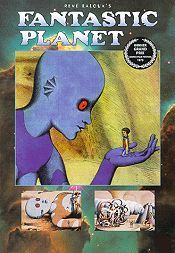
La Planète Sauvage
La Planète Sauvage is a 1973 Krátký Film Praha animated feature film from Krátký Film Praha, Les Films Armorial, Service de la Recherche ORTF, Ceskoslovensky Filmexport, directed by René Laloux.
Also known as: La Planete Sauvage
English title: Fantastic Planet
- Studio
- Krátký Film Praha, Les Films Armorial, Service de la Recherche ORTF, Ceskoslovensky Filmexport
- Distributor
- Argos Films, New World Pictures
Synopsis
On the fantastic planet of Ygam, located in a far solar system, a race of huge blue creatures called Draags keep Oms as domesticated pets. Oms are the descendants of the human survivors of Earth, comparably antlike in size and mistreated by the Draags. With the aid of a Draag knowledge device, an escaped orphaned Om manages to unite a society of wild Oms to revolt against their oppression. The wild Oms attack the Draags in their most vulnerable spot, a mystical moon orbiting around their home world: a moon which holds a powerful secret to the Draags' existence.
Characters
Tiwa, Terr, Master Sinh, Commentator
Credits
Directing
- Director
- René Laloux
Producing
- Producer
- Simon Damiani, Anatole Dauman, Andre Valio-Cavaglione
Writing
- Writer
- Steve Hayes, René Laloux, Roland Topor
- Original Novel "Oms En Serie"
- Stefan Wul
Voices
- Voice
- Jennifer Drake (Tiwa), Eric Baugin (Terr), Jean Topart (Master Sinh), Jean Valmont (Adult Terr, Commentator), Sylvie Lenoir, Michèle Chahan, Yves Barsacq, Hubert de Lapparent, Gérard Hernandez, Claude Joseph, Philippe Ogouz, Jacques Ruisseau
- Vocal Talent, English Version
- Barry Bostwick (Narrator), Mark Gruner, Cynthia Adler, Nora Heflin, Marvin Miller, Monika Ramirez, Hal Smith, Olan Soulé, Janet Waldo
Music
- Music
- Alain Goraguer
Animation
- Animation Directors
- Jindrich Barta, Zdena Bartova, Bohumil Sedja, Zdenek Sob, Karel Strebl, Jiri Vokoum
- Animator
- Jindriska Beberova, Nadazda Svorakova, Zuzana Jupova, Eva Kretzerova, Katerina Novakova, Alena Wellnerova, Helena Horalkova
- Animation Studio
- Prague
Art Department
- Graphics, Characters
- Josef Kabrt
- Graphics, Decoration
- Josef Vana
Editing
- Editor
- Hélène Arnal, Marta Látalová
- Editors, English Version
- Dick Elliott, Rich Harrison
Sound
- Sound Background
- Jean Guérin (EMS Synthesizer)
- Sound
- Jean Carrere, René Renault
- Sound Mixing
- Paul Bertault
Crew
- Production Director
- Vaclav Strnad
- Original Drawings
- Roland Topor
- Scenery
- Lubomir Rejthar, Boris Baromykin
- Noise
- Robert Pouret
- Post-Synchronization Collaboration
- Hélène Tossy
- Laboratories
- GTC Joinville, Barrandov-Prague
Companies and other credits
- Music: Alain Goraguer (Claude Pascal Musical Editions)
- Animation Studio: Studio Jiří Trnka Jiri Trnka (Kratky Film)
Production notes
Production began in 1968.
First shown publicly at the Cannes Film Festival, May 1973. Commercial release: December 6, 1973. Re-released in February 1977.
Also known as: "Divoká Planeta" (Czechoslovakia), "The Fantastic Planet", "Planet of Incredible Creatures" and "The Savage Planet."
Production design based on the artwork and drawings of Roland Topor.
A joint production by French and Czechoslovakian filmmakers. The movie was seen as a metaphor for Soviet oppression of Czechoslovakia, and pressure from the Communist government forced the production to move to France, where it was completed.
Originally brought to America in the early 1970s through Roger Corman's New World Pictures "European Acquisitions," the film was wildly successful on the B-movie circuit with the "post-hippie trippers," seen as a metaphor for class struggle.
Awards
Grand Prix Award, Cannes Film Festival, 1973.
Prize of International Jury, 11th Science Fiction Film Festival, Trieste.
Grand Prize of Animated Film with Gold Medal, Atlanta Festival.
Three Grand Prizes, Film Festival for Children and Youth, Teheran
Pictures

Reviews
La Planète Sauvage
Here is yet another excellent Sci Fi animation from France! If you missed this one - You must see it! It is a moral imperative! Class act storyline, animation is old-school (70's) low frame-rate, the sound effects make up for the short-comings and then some...once you get into it - you'll love it and won't care. This is a classic not to be missed!
Elsewhere: Wikipedia